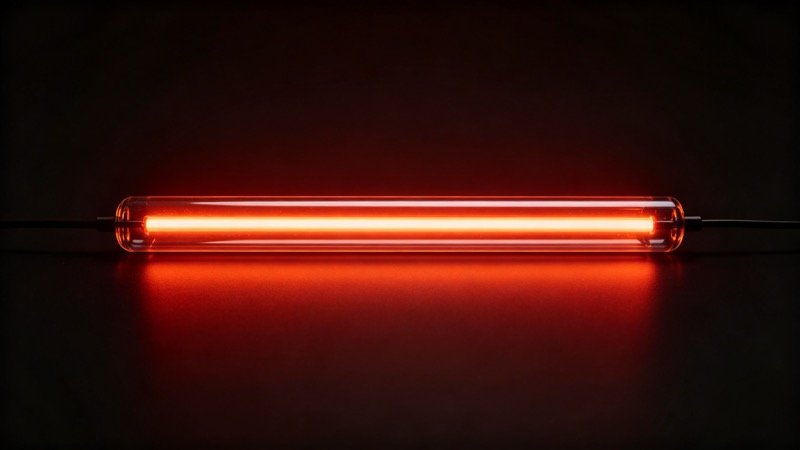
Neon is a noble gas discovered in 1898 by Ramsay and Travers during the fractional distillation of liquid air. At room temperature it is a colorless, odorless gas with a density around 0.9002 g/L and extraordinarily stable chemistry, forming almost no compounds with any element. Its best-known use is neon signs: low-pressure neon gas sealed in a glass tube and energized by a high-voltage field emits a characteristic orange-red light that penetrates fog and lasts a long time, becoming the iconic symbol of 20th-century city commercial streets and bars and giving the industry its name.
Beyond signs, neon is used in glow lamps, voltage testers and small power indicator lamps because it glows stably at low current. The helium-neon laser was one of the first commercial gas lasers; its visible red beam played an important role in precision measurement, alignment, barcode scanning, medical light spots and educational demonstrations, and is still found in some research and teaching instruments. In high-energy physics, liquid neon, like liquid argon, is an ideal medium for time-projection chambers, being sensitive to ionizing radiation and highly transparent. Neon also serves as one of the working media in cryogenic refrigeration and deep-UV lithography lasers, and as a fill gas in certain specialty lamps and high-voltage display tubes.
Neon is a noble gas with a closed electron shell and extraordinarily stable chemistry; it forms almost no stable neutral compounds, so its uses come almost entirely from the physical properties of the elemental gas itself—its emission under electrical excitation and its cryogenic behavior. The only known neon species appear under extreme matrix-isolated or ionic laboratory conditions, cannot be stable at ordinary temperature and pressure, and have no practical industrial or civilian value. What is sold as "neon compounds" generally means gas mixtures containing neon or neon-filled lamps and lasers, not chemical compounds in the strict sense.