Home/ Elements/ Kr
Krypton
Kr 36

Krypton

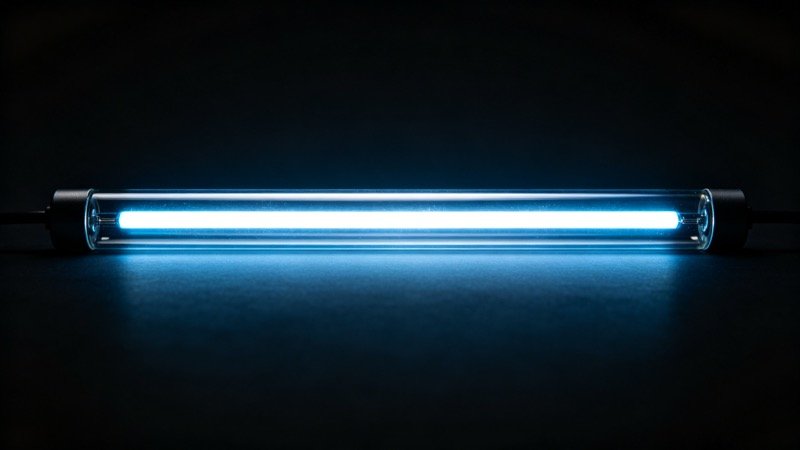
Krypton is a chemical element; it has symbol Kr and atomic number 36. It is a colorless, odorless, tasteless noble gas that occurs in trace amounts in the atmosphere and is often used with other rare gases in fluorescent lamps. Krypton is used commercially as a filling gas for energy-saving fluorescent lights and in some photographic flashes for high-speed photography. Krypton fluoride is also used in some lasers.

Noble Gas colorless gas, exhibiting a w...
Atomic number 36Z
Atomic mass 83.798u
Valence e⁻ 8
Electron config. 1s2 2s2 2p6 3s2 3p6 4s2 3d10 4p6
Density
3.75g/cm³
Melting point
-157°C
Crustal abundance
0.0001ppm
Annual production
Recycling rate
A component of air, regenerated by air fractionation

Why This Element

Krypton occupies a unique niche between light noble gases (Ne, Ar) and heavy ones (Xe, Rn). Its combination of moderate density, good insulating properties, and ability to form transient compounds makes it the ideal filling gas for energy-efficient windows, high-performance lighting, and laser technology.

Applications

Energy-efficient lightingGas lasersInsulated glazingFlash lampsVacuum electronics

Applications in DepthElement & compound uses

Main Uses of the Element

Krypton is a noble gas with a density of about 3.749 g/L and a melting point around −157 °C, much heavier than air and chemically extremely inert. It has irreplaceable uses in lighting, building energy efficiency, and semiconductor lithography. In lighting, krypton is filled into high-intensity discharge lamps and high-performance incandescent lamps: because of its heavy atoms and low thermal conductivity, higher luminous efficiency is achieved inside a smaller bulb, commonly used for airport runway lights, studio lights, and premium automotive headlamps. In building energy efficiency, krypton is used as the fill gas in insulating glass units; with lower thermal conductivity than air it markedly improves window insulation, and is standard in passive houses and premium curtain walls. In semiconductor manufacturing, the krypton-fluoride excimer laser KrF uses 248-nanometer ultraviolet light, a key light source for large-scale integrated circuit lithography, supporting chip fabrication from micron to deep-submicron nodes. Krypton also serves in particle physics detectors and specialty lamp filling.

Key Compounds and Their Uses

Krypton forms very few compounds, and only under extreme conditions. Krypton difluoride KrF2 is one of the few known stable krypton compounds, a colorless solid used as a strong oxidizer and fluorinating agent. The krypton-fluoride excimer KrF is the working medium of lithography lasers, producing 248-nanometer ultraviolet light under discharge and used for chip lithography. Beyond these, krypton forms almost no other stable compounds and is used industrially directly as elemental gas or liquid.
Element History

Discovered in 1898 by William Ramsay and Morris Travers during fractional distillation of liquid air — one of six noble gases isolated by this pair. Present in Earth's atmosphere at approximately 1 part per million by volume (0.000114%). First synthesized compounds (krypton difluoride, KrF₂) were produced in 1963, establishing krypton as the heaviest noble gas to form compounds at room temperature.

Related Elements

He · Helium Ne · Neon Ar · Argon Xe · Xenon Rn · Radon Og · Oganesson

Frequently Asked QuestionsLong-tail Q&A · data-driven

What is the melting point of Krypton?
-157 °C
What is the boiling point of Krypton?
-153 °C
What is the density of Krypton?
3.75 g/cm³
What are the atomic number and category of Krypton?
36 · Noble Gas
Which ore is Krypton mainly extracted from?
none — atmospheric air
What are the main uses of Krypton?
Krypton occupies a unique niche between light noble gases (Ne, Ar) and heavy ones (Xe, Rn). Its combination of moderate density, good insulating properties, and ability to form transient compounds makes it the ideal fill
Who discovered Krypton and when?
William Ramsay · Ancient (known since antiquity)