Home/ Elements/ Bi
Bismuth
Bi 83

Bismuth

Bismuth is a chemical element; it has symbol Bi and atomic number 83. It is a post-transition metal and one of the pnictogens, with chemical properties resembling its lighter group 15 siblings arsenic and antimony. Elemental bismuth occurs naturally, and its sulfide and oxide forms are important commercial ores. Bismuth is the most diamagnetic of all metals and has the lowest thermal conductivity. Bismuth is used in cosmetics (pearlescent pigments), pharmaceuticals (Pepto-Bismol), and as a low-melting-point alloy (eutectic bismuth alloys are used in fire sprinklers).

Post-transition Metal USGS 2025 lustrous silver
Atomic number 83Z
Atomic mass 208.98u
Valence e⁻ 5
Electron config. 1s2 2s2 2p6 3s2 3p6 4s2 3d10 4p6 5s2 4d10 5p6 6s2 4f14 5d10 6p3
Density
9.78g/cm³
Melting point
272°C
Crustal abundance
0.009ppm
Annual production
10000metric tons (refinery)
Recycling rate
Low

Why This Element

Bismuth is the most diamagnetic element (strongest repulsion by magnetic fields) and has the highest Hall coefficient — plus the lowest toxicity among the heavy metals, making it an environmentally friendly replacement for lead across multiple industrial applications. Its primary industrial role is in Pepto-Bismol (bismuth subsalicylate), the most consumed bismuth compound.

Applications

Low-melting alloysPharmaceuticalsSolder replacement

Applications in DepthElement & compound uses

Main Uses of the Element

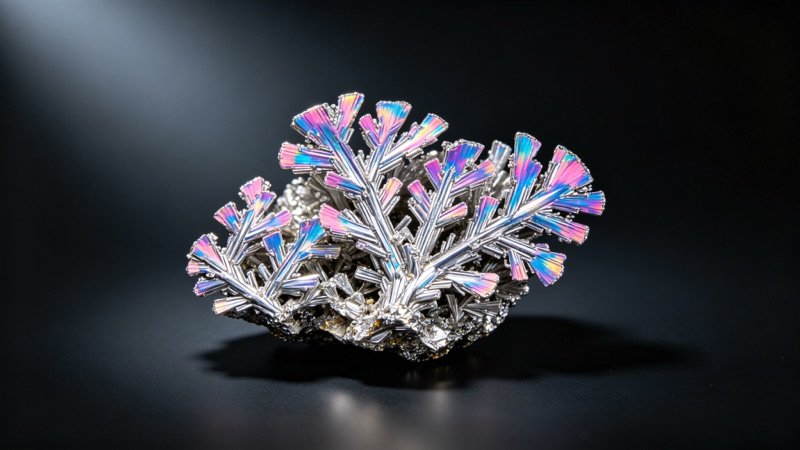
Bismuth is a brittle metal with a silvery-white, slightly pinkish luster: low melting point (about 271 degrees C), non-toxic, and dense. In recent years, driven by the global lead-free trend, it has become an important substitute for lead. Its main industrial use is in low-melting and fusible alloys - mixing bismuth with lead, tin, cadmium and indium can lower the melting point below 70 degrees C, widely used in fusible plugs of fire sprinklers, boiler safety interlocks, automatic fire extinguishing devices and over-temperature protection elements in electrical equipment, which melt and trigger action once the temperature rises. In soldering, lead-free solders and low-temperature solder pastes increasingly use bismuth-based alloys to replace traditional tin-lead solder, for electronics assembly, food machinery and artwork restoration, meeting environmental directives such as RoHS. In medicine, bismuth preparations have a long history: bismuth subsalicylate is a well-known stomach remedy and antidiarrheal ingredient, used to relieve gastric discomfort and in combination therapy for H. pylori, while bismuth subcarbonate is used to protect the gastric mucosa. In consumer goods, bismuth is also used in clock fuses, fireworks (bismuth compounds burn with an emerald-green flame) and, as a lead substitute, in fishing sinkers, shot and weights. Non-toxic, low-melting and easy to process, bismuth is moving from a minor by-product metal to a star of eco-friendly replacement materials.

Key Compounds and Their Uses

Bismuth oxide (Bi2O3) is bismuth's main oxide, a yellow powder used to color and flux ceramics and glass, and as a raw material for electronic ceramics, varistors and certain solid electrolytes, and in chemicals as a catalyst and pigment. Bismuth sulfide (Bi2S3), i.e. bismuthinite, is the main ore of bismuth in nature, gray with metallic luster, and the principal feedstock for bismuth smelting; its semiconductor properties are also of interest in optoelectronic and thermoelectric materials research. Bismuth oxychloride (BiOCl) is a white, pearlescent plate-like crystal with a soft, pearl-like luster, widely used in premium cosmetics as pearl creams, nail polish, eye shadow and talcum powder, and as a pearlescent pigment in high-grade plastics and coatings - an important non-toxic pearl-white in the cosmetics industry. Bismuth subcarbonate (Bi2O2CO3) is one of the main active ingredients in stomach and gastrointestinal medicines, with astringent, mucosa-protective and bacteriostatic effects, used in over-the-counter treatments for gastritis, gastric ulcer and diarrhea. In addition, bismuth subsalicylate is a well-known antidiarrheal ingredient, and bismuth-tin oxides are also used in certain specialty glasses and electronic ceramics.
Element History

Known to alchemists as 'bisemutum' but confused with tin and lead until 1753, when Claude François Geoffroy proved it a distinct element. Bismuth-209, once thought radioactive, is stable (its alpha decay has a 1.9e19 year half-life, making it practically stable). Currently recovered as a byproduct of lead, tin, and copper mining from China, Peru, and Mexico.

Alloys of this element (1)

View all alloys → Wood's metal

Related Elements

Al · Aluminium Ga · Gallium In · Indium Sn · Tin Tl · Thallium Pb · Lead Po · Polonium Fl · Flerovium

Frequently Asked QuestionsLong-tail Q&A · data-driven

What is the melting point of Bismuth?
272 °C
What is the boiling point of Bismuth?
1564 °C
What is the density of Bismuth?
9.78 g/cm³
What are the atomic number and category of Bismuth?
83 · Post-transition Metal
Which ore is Bismuth mainly extracted from?
Bismuthinite
What are the world reserves of Bismuth?
320000 tonnes
What is the annual production of Bismuth?
10000 metric tons (refinery)
What are the main uses of Bismuth?
Bismuth is the most diamagnetic element (strongest repulsion by magnetic fields) and has the highest Hall coefficient — plus the lowest toxicity among the heavy metals, making it an environmentally friendly replacement f
Who discovered Bismuth and when?
Claude François Geoffroy · 1753