Home/ Elements/ Ga
Gallium
Ga 31

Gallium

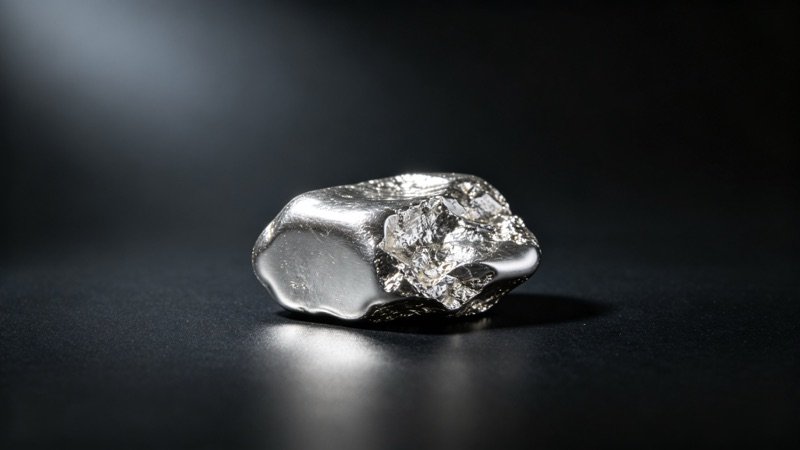
Gallium is a chemical element; it has symbol Ga and atomic number 31. Discovered by the French chemist Paul-Émile Lecoq de Boisbaudran in 1875, elemental gallium is a soft, silvery metal at standard temperature and pressure. Its melting point of 29.76 °C means it will melt in a person's hand. Gallium is used primarily in semiconductors (gallium arsenide, gallium nitride for LEDs), thermometers, and as a substitute for mercury in medical thermometers and barometers.

Post-transition Metal USGS 2025 silver-white
Atomic number 31Z
Atomic mass 69.723u
Valence e⁻ 3
Electron config. 1s2 2s2 2p6 3s2 3p6 4s2 3d10 4p1
Density
5.91g/cm³
Melting point
30°C
Crustal abundance
19.0ppm
Annual production
760000kilograms
Recycling rate
Low (by-product)

Why This Element

Gallium has the lowest melting point of any metal that remains liquid at body temperature (29.76°C) but an extremely high boiling point (2,204°C), creating the widest liquid range of any element. Its semiconductor properties (direct bandgap 1.42 eV matching sunlight) make it essential to LED lighting and solar cells.

Applications

Integrated circuits
73%
Optoelectronic devices
26%

Applications in DepthElement & compound uses

Main Uses of the Element

Gallium is a rare, low-abundance dispersed metal with an extremely low melting point; it almost never forms its own ore and is mainly extracted as a by-product from the Bayer liquor of alumina refining, yet it underlies the entire compound-semiconductor industry. Its largest use is in gallium arsenide (GaAs) and gallium nitride (GaN) wafers: GaAs powers RF power amplifiers, cellular base stations and satellite communications chips, with high-frequency performance superior to silicon, while GaN enables fast chargers, 5G base stations and lidar, with power density and efficiency far exceeding conventional silicon devices. In LEDs, GaN-based blue chips are the light-emitting core of white LEDs, which together with phosphors deliver energy-efficient lighting and displays. In solar power, multi-junction GaAs cells are used on satellites and space probes and lead all photovoltaic technologies in conversion efficiency. Gallium is also used in infrared optical lenses, low-melting alloys and nuclear-medicine tracers—a classic example of a strategic 'bottleneck' metal consumed in small quantities.

Key Compounds and Their Uses

Gallium arsenide (GaAs) is the flagship material of second-generation compound semiconductors, used in RF devices, laser diodes and GaAs solar cells, and is irreplaceable in satellites, mobile phones and optical communications. Gallium nitride (GaN) is a wide-bandgap semiconductor that forms the core material of blue LEDs, fast-charging power devices and 5G RF amplifiers, with demand surging in recent years as GaN chargers and base-station chips scale up. Gallium oxide (Ga2O3) is an emerging ultra-wide-bandgap oxide semiconductor drawing strong interest for deep-UV solar-blind detectors and power devices. Indium gallium arsenide (InGaAs) is an important ternary compound semiconductor used in detectors and lasers for fiber-optic communications and as the photosensitive surface of infrared night-vision imagers, making it a key material for optical communications and infrared equipment.
Element History

Predicted in 1871 by Mendeleev as 'eka-aluminum' and described with extraordinary accuracy (density 5.9 g/cm³, melting point low enough for melting in hand). Discovered spectroscopically in 1875 by Lecoq de Boisbaudran in zinc blende from Pyrenees, then isolated via electrolysis.

Alloys of this element (1)

View all alloys → Galinstan

Related Elements

Al · Aluminium In · Indium Sn · Tin Tl · Thallium Pb · Lead Bi · Bismuth Po · Polonium Fl · Flerovium

Frequently Asked QuestionsLong-tail Q&A · data-driven

What is the melting point of Gallium?
30 °C
What is the boiling point of Gallium?
2400 °C
What is the density of Gallium?
5.91 g/cm³
What are the atomic number and category of Gallium?
31 · Post-transition Metal
Which ore is Gallium mainly extracted from?
bauxite (byproduct)
What are the world reserves of Gallium?
1100000 kilograms
What is the annual production of Gallium?
760000 kilograms
What are the main uses of Gallium?
Gallium has the lowest melting point of any metal that remains liquid at body temperature (29.76°C) but an extremely high boiling point (2,204°C), creating the widest liquid range of any element. Its semiconductor proper
Who discovered Gallium and when?
Lecoq de Boisbaudran · 1875