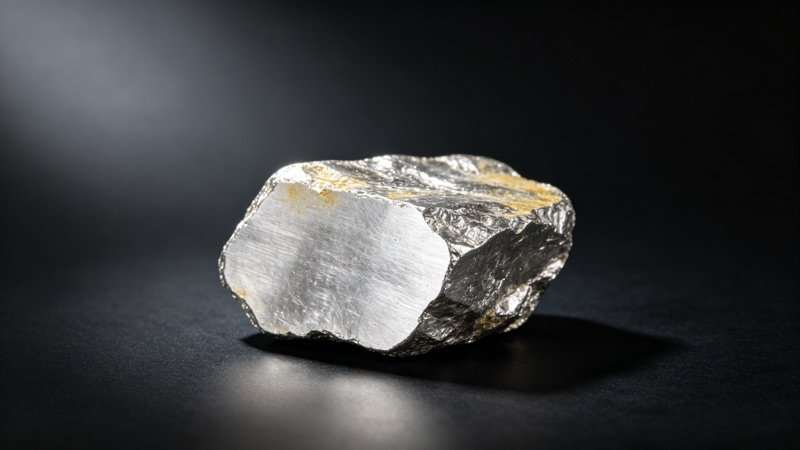
Americium is perhaps the most "familiar" artificial radioactive element in everyday life. Its best-known genuine consumer application is the ionization chamber of household smoke detectors: each detector contains a few micrograms of americium-241, whose alpha radiation ionizes a small amount of air to sustain a stable, weak current. When smoke enters the chamber, ions are adsorbed and recombined on smoke particles, the current drops, and an alarm is triggered. Because americium-241 has a long half-life of about 432 years, its alpha particles have an extremely short range, and the detector casing provides sufficient shielding, this small source has been used in tens of millions of smoke detectors over several decades. Americium-241 has also served as a low-energy gamma source in portable density gauges, moisture meters, and oil-well logging, though the quantities involved are small. Beyond these uses, americium has no other large-scale industrial application.
Americium compounds such as americium dioxide (AmO2) are the chemical form actually sealed inside smoke detectors: a trace amount of oxide powder is typically pressed into a pellet and hermetically sealed in a metal capsule. Other compounds, such as americium trichloride (AmCl3), are prepared only in trace amounts in radiochemical laboratories for separation and tracer studies.