Home/ Elements/ Pa
Protactinium
Pa 91

Protactinium

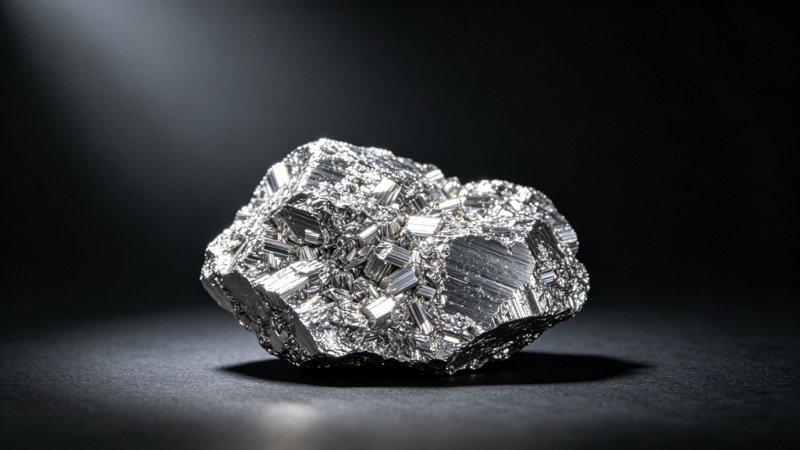
Protactinium is a chemical element; it has symbol Pa and atomic number 91. It is a dense, silvery-gray actinide metal that readily reacts with oxygen, water vapor, and inorganic acids. Protactinium is one of the rarest and most expensive naturally occurring elements. It was first identified in 1913, and the element was finally extracted in 1934. Protactinium-231 has a half-life of 32,760 years. Due to its extreme rarity and high radioactivity, protactinium has no commercial uses and is only used for scientific research.

Actinide bright, silvery metallic luster
Atomic number 91Z
Atomic mass 231.036u
Valence e⁻ 2
Electron config. 1s2 2s2 2p6 3s2 3p6 4s2 3d10 4p6 5s2 4d10 5p6 6s2 4f14 5d10 6p6 7s2 5f2 6d1
Density
15.37g/cm³
Melting point
1568°C
Crustal abundance
1.4e-06ppm
Annual production
—
Recycling rate
0%(Radioactive element; no recycling stream)

Why This Element

Protactinium is one of Earth's rarest elements — Pa-231 occurs at only ~1 ppb in uranium ores, and ~125 tonnes total exist in Earth's crust at secular equilibrium. No stable isotopes exist; the longest-lived, Pa-231, still has a half-life of 32,760 years. No industrial applications — exclusively used in fundamental radiometric dating.

Applications

Research

Applications in DepthElement & compound uses

Main Uses of the Element

Protactinium is one of the rarest of the actinide elements. It occurs naturally in uranium ores, but one tonne of pitchblende contains only about 0.1 milligrams of protactinium-231; although its most stable isotope, protactinium-231, has a half-life of about 32,700 years, it has never been enriched to an industrially usable concentration. Because it is extremely scarce, highly radioactive, and chemically complex, protactinium has no practical use. Today it serves solely as a subject of nuclear physics and actinide chemistry research, studied chiefly to understand actinide bonding behavior and nuclear properties.

Key Compounds and Their Uses

Protactinium compounds such as protactinium(V) oxide (Pa2O5) and protactinium(V) chloride (PaCl5) are obtained only by trace-scale separation from irradiated targets and uranium ore residues in the laboratory. They are used for chemical research and have never entered any consumer or industrial product.

Element History

Predicted as 'eka-tantalum' by Mendeleev in 1871. First detected spectroscopically in 1913 by Kasimir Fajans and Oswald Göhring (isotope Pa-234). Isolated as pure metal in 1934 by Aristid V. Grosse. All natural protactinium is Pa-231 (32,760-year half-life), occurring in uranium ores at ~1 ppb.

Related Elements

Ac · Actinium Th · Thorium U · Uranium Np · Neptunium Pu · Plutonium Am · Americium Cm · Curium Bk · Berkelium

Frequently Asked QuestionsLong-tail Q&A · data-driven

What is the melting point of Protactinium?
1568 °C
What is the boiling point of Protactinium?
4027 °C
What is the density of Protactinium?
15.37 g/cm³
What are the atomic number and category of Protactinium?
91 · Actinide
Which ore is Protactinium mainly extracted from?
Pitchblende
What are the main uses of Protactinium?
Protactinium is one of Earth's rarest elements — Pa-231 occurs at only ~1 ppb in uranium ores, and ~125 tonnes total exist in Earth's crust at secular equilibrium. No stable isotopes exist; the longest-lived, Pa-231, sti
Who discovered Protactinium and when?
William Crookes · 1917