Home/ Elements/ Bk
Berkelium
Bk 97

Berkelium

Berkelium is a chemical element; it has symbol Bk and atomic number 97. It is a member of the actinide and transuranium element series. It was named in honor of the city of Berkeley, California, where it was discovered at the Lawrence Berkeley National Laboratory. Berkelium was first synthesized in December 1949 by Stanley Thompson, Albert Ghiorso, and Glenn Seaborg by bombarding americium-241 with alpha particles. Due to its rarity and radioactivity, berkelium has no commercial applications and is only used for scientific research.

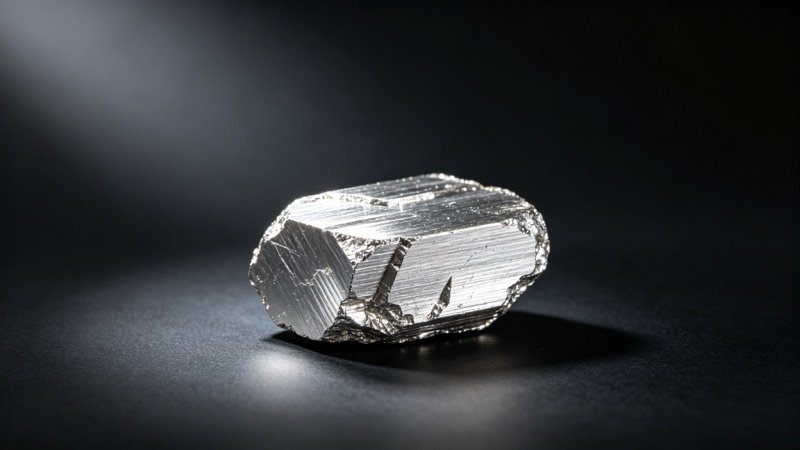
Actinide silvery
Atomic number 97Z
Atomic mass 247u
Valence e⁻ 2
Electron config. 1s2 2s2 2p6 3s2 3p6 4s2 3d10 4p6 5s2 4d10 5p6 6s2 4f14 5d10 6p6 7s2 5f9
Density
14.78g/cm³
Melting point
986°C
Crustal abundance
1e-16ppm
Annual production
Recycling rate
0%(Radioactive element; no established recycling)

Why This Element

Berkelium has no commercial applications. It served as the target material for the discovery of heavier transuranium elements — notably, Bk-249 was bombarded with carbon ions to synthesize element 107 (Bohrium) and element 117 (Tennessine). Studied in fundamental actinide chemistry.

Applications

Research

Applications in DepthElement & compound uses

Main Uses of the Element

Berkelium is an artificial actinide element that can only be prepared by irradiating curium or americium targets in high-flux reactors; each worldwide production run is measured in micrograms or even nanograms, and no appreciable quantity can be accumulated. Because it is extremely scarce and highly radioactive, berkelium has no industrial, medical, or consumer use. To this day it serves only as a target material for superheavy-element synthesis (used to bombard targets in the production of heavier elements such as californium and einsteinium) and as a subject of fundamental actinide chemistry research.

Key Compounds and Their Uses

Berkelium compounds such as berkelium trichloride (BkCl3) and berkelium dioxide (BkO2) are prepared only in tiny, just-weighable batches in the laboratory, where they are used in actinide valence-state and coordination-chemistry studies; they have no application at any scale.

Element History

Discovered in 1949 at UC Berkeley by Seaborg's team during alpha bombardment of Am-241 — berkelium-243 (4.5-hour half-life) was the first isotope identified. Isolated as pure metal in 1962. All berkelium isotopes are radioactive; longest-lived Bk-247 has a 1,380-year half-life. No natural occurrence exists.

Related Elements

Ac · Actinium Th · Thorium Pa · Protactinium U · Uranium Np · Neptunium Pu · Plutonium Am · Americium Cm · Curium

Frequently Asked QuestionsLong-tail Q&A · data-driven

What is the melting point of Berkelium?
986 °C
What is the boiling point of Berkelium?
2627 °C
What is the density of Berkelium?
14.78 g/cm³
What are the atomic number and category of Berkelium?
97 · Actinide
Which ore is Berkelium mainly extracted from?
Nuclear reactor (synthetic)
What are the main uses of Berkelium?
Berkelium has no commercial applications. It served as the target material for the discovery of heavier transuranium elements — notably, Bk-249 was bombarded with carbon ions to synthesize element 107 (Bohrium) and eleme
Who discovered Berkelium and when?
Lawrence Berkeley National Laboratory · 1949