Home/ Elements/ Te
Tellurium
Te 52

Tellurium

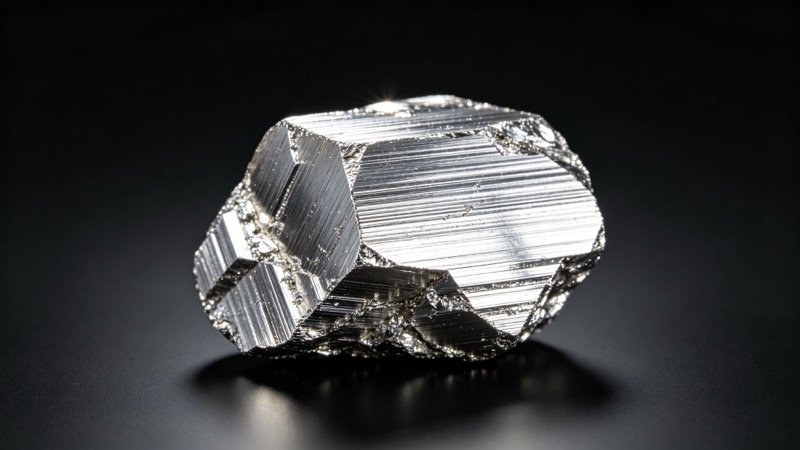
Tellurium is a chemical element; it has symbol Te and atomic number 52. It is a brittle, mildly toxic, rare, silver-white metalloid. Tellurium is chemically related to selenium and polonium. It is sometimes found in its native form, as elemental crystals. Tellurium is far more common in the universe as a whole than on Earth. Its extreme rarity in the Earth's crust, comparable to that of platinum, is partly due to its high atomic number. Tellurium is primarily used in solar panels (cadmium telluride), alloys, and as a vulcanizing agent in rubber.

Metalloid USGS 2025 d47a00
Atomic number 52Z
Atomic mass 127.603u
Valence e⁻ 6
Electron config. 1s2 2s2 2p6 3s2 3p6 4s2 3d10 4p6 5s2 4d10 5p4
Density
6.24g/cm³
Melting point
450°C
Crustal abundance
0.001ppm
Annual production
10980metric tons
Recycling rate
Mainly byproduct recovery from copper anode slimes

Why This Element

Tellurium is one of the rarest stable elements in Earth's crust (0.001 ppm) — rarer than gold or platinum. Its industrial value stems from its role in high-performance metallurgical alloys and emerging solar cell technologies, where tellurium's unique semiconductor properties (bandgap 1.5 eV matching the solar spectrum) enable next-generation photovoltaics.

Applications

SemiconductorsPhotovoltaicsMetallurgical additivesRubber acceleratorsThermoelectric materials

Applications in DepthElement & compound uses

Main Uses of the Element

Tellurium, discovered in 1782, is a rare metalloid with density 6.24 g/cm³ and melting point 450 °C, occurring only as a trace byproduct in copper and gold ores. It is used in tiny amounts, yet changes material performance in steel, alloys and new-energy materials. In metallurgy, a small tellurium addition to low-carbon and free-machining steel improves machinability by making chips break cleanly and extending tool life; adding it to copper alloys raises conductivity and corrosion resistance for cable lugs and electrical terminals. The largest emerging use is cadmium telluride (CdTe) thin-film solar cells, where a near-micron-thick CdTe absorber layer converts sunlight at low cost with good weak-light performance, making CdTe one of the few thin-film PV routes commercialized at scale. Phase-change memory exploits the rapid resistance switching of tellurium-based alloys between crystalline and amorphous states, serving as high-speed storage media in solid-state drives and being explored for neuromorphic chips. Tellurium is also used as a rubber vulcanizer, ceramic colorant and infrared optical element.

Key Compounds and Their Uses

Cadmium telluride (CdTe) is tellurium's most industrially meaningful compound, forming the absorber layer of thin-film solar cells: with a direct bandgap and extremely high absorption coefficient, a few microns absorb most visible light, letting modules stay thin, perform well in weak light, and reach commercial deployment in utility-scale PV plants. Tellurium dioxide (TeO2) is a white crystal valued for its strong acousto-optic effect, used in acousto-optic modulators, deflectors and infrared windows for lasers and fiber-optic telecom. Bismuth telluride (Bi2Te3) is the classic room-temperature thermoelectric material, combining low lattice thermal conductivity with a high Seebeck coefficient; it powers portable thermoelectric coolers, localized CPU cooling and miniature waste-heat modules, and is a familiar semiconductor in consumer electronics. Zinc telluride (ZnTe) is used for infrared windows and LED doping. Sodium tellurite (Na2TeO3) is a minor additive in electroplating baths and microbiological media.
Element History

Discovered in 1782 by Franz-Joseph Müller von Reichenstein in gold ore from the Apuseni Mountains (Romania). Müller identified it as a new substance but couldn't isolate it; Martin Heinrich Klaproth formally named and isolated it two years later. Production comes primarily as byproduct of copper anode slime refining and lead-zinc mining.

Alloys of this element (5)

View all alloys → CdTe Bi2Te3 PbTe CdMgTe TAGS

Related Elements

B · Boron Si · Silicon Ge · Germanium As · Arsenic Sb · Antimony

Frequently Asked QuestionsLong-tail Q&A · data-driven

What is the melting point of Tellurium?
450 °C
What is the boiling point of Tellurium?
988 °C
What is the density of Tellurium?
6.24 g/cm³
What are the atomic number and category of Tellurium?
52 · Metalloid
Which ore is Tellurium mainly extracted from?
calaverite, sylvanite, telluride ores
What are the world reserves of Tellurium?
35000 metric tons
What is the annual production of Tellurium?
10980 metric tons
What are the main uses of Tellurium?
Tellurium is one of the rarest stable elements in Earth's crust (0.001 ppm) — rarer than gold or platinum. Its industrial value stems from its role in high-performance metallurgical alloys and emerging solar cell technol
Who discovered Tellurium and when?
Franz-Joseph Müller von Reichenstein · 1782