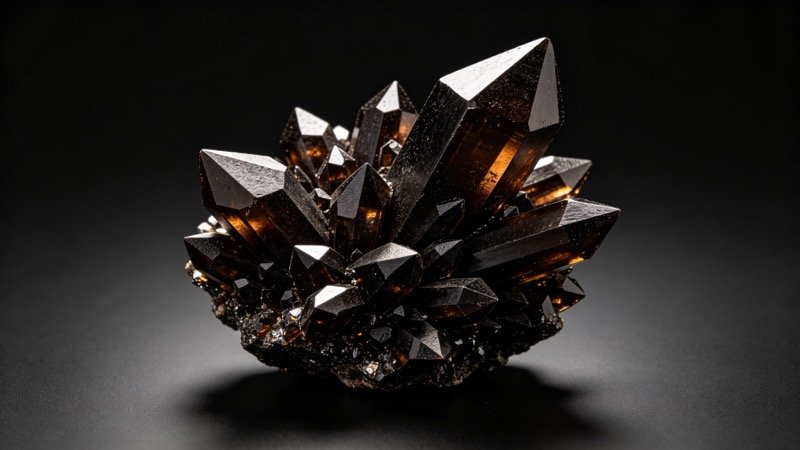
Boron is a metalloid: a black or grayish solid at room temperature, hard, high-melting and refractory, with a density around 2.08 g/cm³. It is used as a functional rather than structural material—a small-quantity, high-value element. Its largest industrial consumption is in glass and ceramics: adding boron oxide to borosilicate glass lowers the thermal expansion coefficient and improves thermal shock resistance, yielding laboratory beakers, ovenproof cookware and solar-panel cover glass. In metallurgy, boron is added as ferroboron or boron master alloys in trace amounts to improve the hardenability of steel; a tiny boron addition can substantially reduce the need for expensive nickel and chromium, which is why it is widely used in automotive gears, bolts and high-strength structural parts.
Boron fibers offer a high specific strength and excellent heat resistance; when combined with epoxy or aluminum they form boron-fiber-reinforced composites used in aerospace structures and in sporting goods such as golf shafts and tennis rackets. In the nuclear industry, the boron-10 isotope absorbs neutrons extremely strongly and is fabricated into control rods, shielding materials and emergency shutdown balls, making it critical to reactor safety. In semiconductors, boron is the standard p-type dopant introduced into silicon single crystals and is indispensable for forming PN junctions and power devices. Boron is also used in E-glass fiber production, flame retardants and agricultural boron fertilizers that support pollination and cell-wall formation in crops.
Boron trioxide (B2O3) is a fundamental fluxing component in borosilicate glass, enamel and flame-resistant glass, and is used to manufacture borosilicate and optical glasses. Boric acid (H3BO3) has mild antiseptic and astringent properties and is used in eye drops, baby powder, wood preservation and flame-retardant treatments, and it is also an intermediate for other boron compounds. Sodium tetraborate decahydrate (Na2B4O7·10H2O) is borax, historically used as a welding flux to remove oxide films from metals; it also appears in traditional blue-and-white porcelain glazes and enamels, while modern uses center on detergent builders, ceramic glazes and glass-fiber production. Boron nitride (BN), known as white graphite, has a graphite-like structure, lubricates at high temperature while remaining electrically insulating, and is used as a high-temperature release agent, thermal-interface material and smooth filler in cosmetics; hexagonal BN ceramics also serve as high-temperature crucibles and semiconductor epitaxy substrates. Boron carbide (B4C) is second only to diamond and cubic boron nitride in hardness, and is used in bulletproof armor, sandblast nozzles, lapping and polishing, and as a neutron absorber in nuclear reactors.