Home/ Elements/ Sb
Antimony
Sb 51

Antimony

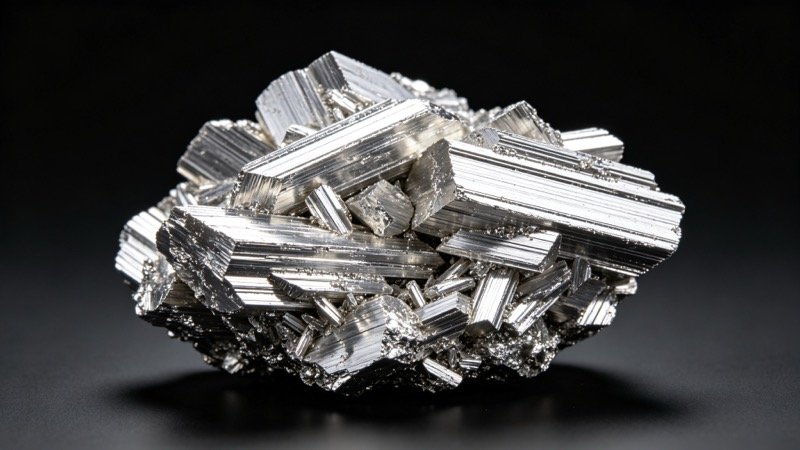
Antimony is a chemical element; it has symbol Sb (from Latin: stibium) and atomic number 51. A lustrous gray metalloid, it is found in nature mainly as the sulfide mineral stibnite (Sb2S3). Antimony compounds have been known since ancient times and were powdered for use as medicine and cosmetics. The largest applications for metallic antimony are as an alloying material for lead and tin to improve hardness and mechanical strength, and as a flame retardant in plastics, textiles, and rubber.

Metalloid USGS 2025 silvery lustrous gray
Atomic number 51Z
Atomic mass 121.76u
Valence e⁻ 5
Electron config. 1s2 2s2 2p6 3s2 3p6 4s2 3d10 4p6 5s2 4d10 5p3
Density
6.7g/cm³
Melting point
631°C
Crustal abundance
0.2ppm
Annual production
100000metric tons
Recycling rate
Antimony recycled together with lead-acid battery scrap

Why This Element

Antimony is a brittle metalloid with excellent fire retardant properties that serve as its dominant industrial value — antimony trioxide combined with halogenated compounds produces synergistic flame retardants widely used in plastics and textiles. Alloys of antimony with lead and tin improve hardness and castability for storage batteries and solder.

Applications

Flame retardantsRechargeable batteriesBearing alloysSemiconductorsChemical catalysts

Applications in DepthElement & compound uses

Main Uses of the Element

Antimony is a metalloid between metal and nonmetal, density 6.697 g/cm³, melting point 631 °C. Brittle and silvery, it cannot serve as a structural material on its own, yet holds an irreplaceable niche in flame retardancy, batteries and type metals. Its largest use is as a flame-retardant synergist paired with halogen systems in plastics, rubber and coatings: Sb2O3 itself does not burn, but at high temperature it reacts with halogens to release antimony oxides that capture free radicals and slow polymer ignition, so it is ubiquitous in wire and cable jackets, appliance housings, furniture and textiles. In lead-acid batteries, a small antimony addition hardens the grid, improves castability and suppresses gassing, making starting and backup batteries more cycle-resistant. For printing and bearings, antimony's slight expansion on solidification matters: tin-lead-antimony type alloys cast sharp, clean letterforms and were the heart of movable-type printing; tin-based babbitt alloys containing antimony serve as main and connecting-vehicle bearings. Antimony also appears in military detonators, pyrotechnic colorants and glass fining.

Key Compounds and Their Uses

Antimony trioxide (Sb2O3), known as antimony white, is the most important compound, a white crystalline powder with limited flame retardancy on its own but strong synergy with halogenated retardants in plastics and textiles, and is the workhorse system in cables, TV casings, toys and polyurethane foam. Antimony trisulfide (Sb2S3), stibnite, is the main ore for smelting; historically used in match heads and military primer compositions for its friction-ignition property, it now also goes into black glass and infrared windows. Antimony trichloride (SbCl3), once called butter of antimony, was used for antiqued gilding and as an emetic, and now serves mainly as a chlorination catalyst in organic synthesis. Indium antimonide (InSb) and gallium antimonide (GaSb) are important semiconductors used in infrared detectors, Hall sensors and terahertz devices. Antimony pentoxide (Sb2O5) is used as a flame retardant and polyester polymerization catalyst.
Element History

Known since antiquity — stibnite was used as eye makeup by ancient Egyptians and as a medicine in Greece and Rome. First described as a distinct metal in 1540 by Vannoccio Biringuccio. Commercial production today comes primarily from stibnite deposits in China, Russia, and Bolivia.

Related Elements

B · Boron Si · Silicon Ge · Germanium As · Arsenic Te · Tellurium

Frequently Asked QuestionsLong-tail Q&A · data-driven

What is the melting point of Antimony?
631 °C
What is the boiling point of Antimony?
1635 °C
What is the density of Antimony?
6.7 g/cm³
What are the atomic number and category of Antimony?
51 · Metalloid
Which ore is Antimony mainly extracted from?
stibnite
What are the world reserves of Antimony?
2000000 metric tons
What is the annual production of Antimony?
100000 metric tons
What are the main uses of Antimony?
Antimony is a brittle metalloid with excellent fire retardant properties that serve as its dominant industrial value — antimony trioxide combined with halogenated compounds produces synergistic flame retardants widely us
Who discovered Antimony and when?
unknown, before 3000 BC · Ancient (known since antiquity)