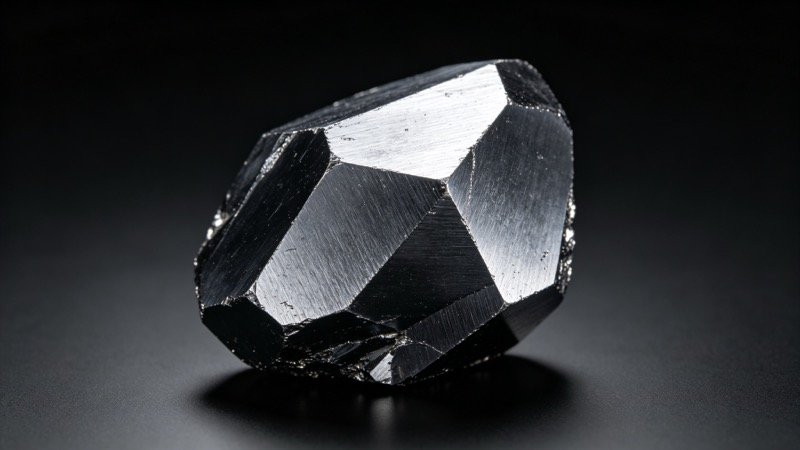
Germanium is a metalloid semiconductor with a density of about 5.323 g/cm³ and a melting point around 938 °C, combining metallic luster with semiconductor behavior. It is scarce in the crust and recovered mainly as a byproduct of zinc ores and coal ash. It holds a key position in modern optoelectronics and infrared technology. In fiber-optic communications, germanium dioxide derived from germanium tetrachloride is doped into the core of silica fibers, raising the refractive index and lowering optical loss, making it the core dopant for long-haul communication fibers. In infrared optics, germanium is highly transparent to infrared light and is used to make lenses and windows for thermal imagers, infrared night-vision devices, and missile guidance systems, widely applied in defense, security, and industrial thermometry. In semiconductors, germanium was the substrate material for early transistors; today it is used in silicon-germanium heterojunctions, solar cells, and high-purity germanium detectors, the latter serving nuclear radiation detection and gamma spectroscopy.
Germanium dioxide GeO2 is germanium's most important compound, used for fiber-core doping and infrared optical glass, and also as a PET catalyst. Germanium tetrachloride GeCl4 is a key intermediate in the fiber industry: germanium is chlorinated and then oxidized to GeO2, which is deposited onto a silica preform, and it is also a raw material for infrared optical coatings. Germane GeH4 is a highly toxic gas used for semiconductor epitaxy, in chemical vapor deposition of germanium-silicon films. Chalcogenides such as germanium monosulfide GeS and germanium monoselenide GeSe are transparent in the long-wave infrared and are studied for infrared windows and optical switches. Bismuth germanate BGO crystal is a scintillator material used in high-energy physics detectors and medical PET scanners. High-purity germanium single crystal, though not a compound, serves as a detector material for nuclear radiation measurement and gamma-ray spectroscopy.