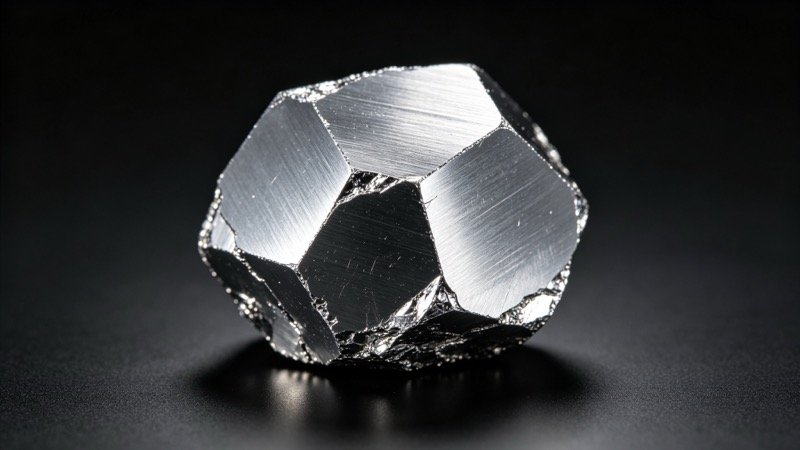
Silicon is the second most abundant element in Earth's crust, after oxygen. At room temperature it is a grayish-black, metalloid-looking solid with a density around 2.329 g/cm³ and a melting point of 1414°C, and it is the cornerstone of the modern semiconductor and photovoltaic industries. Its largest and most closely watched use is in semiconductor wafers: quartz sand is carbothermally reduced to metallurgical-grade silicon, further purified to electronic-grade polysilicon via the Siemens or fluidized-bed process, then drawn into single-crystal ingots, sliced and polished to become the substrate for everything from smartphone processors and computer CPUs to automotive power devices and AI chips. Solar cells are another major market; polycrystalline and monocrystalline silicon PV panels convert sunlight directly into electricity and have been one of the fastest-growing energy technologies of the past decade.
In traditional metallurgy, silicon is the most important deoxidizer and alloying element in steelmaking and cast iron: silicon steel sheet (electrical steel), containing a few percent silicon, has high magnetic permeability and low core loss and is the irreplaceable soft-magnetic material for transformer and motor cores, directly determining the energy efficiency of power grids and home appliances. In building materials, Portland cement, glass and ceramics use silicon dioxide as their main raw material, underpinning the global construction industry. Silicon also enters daily life as silanes, silicone oils, silicone rubber and silicone resins, appearing in cosmetics, waterproof coatings, baby nipples, medical catheters and high-temperature seals, making it an element that spans metallurgy, electronics, energy and consumer goods.
Silicon dioxide (SiO2) occurs as quartz sand, quartzite and rock crystal, and is the foundational raw material for glass, cement, ceramics and high-purity silicon production, as well as the core material of optical fibers, lenses and quartz crucibles. Silicon carbide (SiC), known as carborundum, is hard, high-temperature resistant and oxidation resistant, and is used as an abrasive, refractory material and third-generation wide-bandgap semiconductor substrate for EV chargers, renewable-energy inverters and high-speed-traction converter modules. Sodium silicate (Na2SiO3), commonly called water glass or soluble glass, is a widely used chemical for foundry sand binders, detergent builders, paper coating and tunnel grouting. Silane (SiH4) is the precursor gas used in the electronics industry to deposit ultra-pure silicon films, silicon nitride and epitaxial layers, and is a key source gas for solar-cell and display coatings.