Home/ Elements/ Pt
Platinum
Pt 78

Platinum

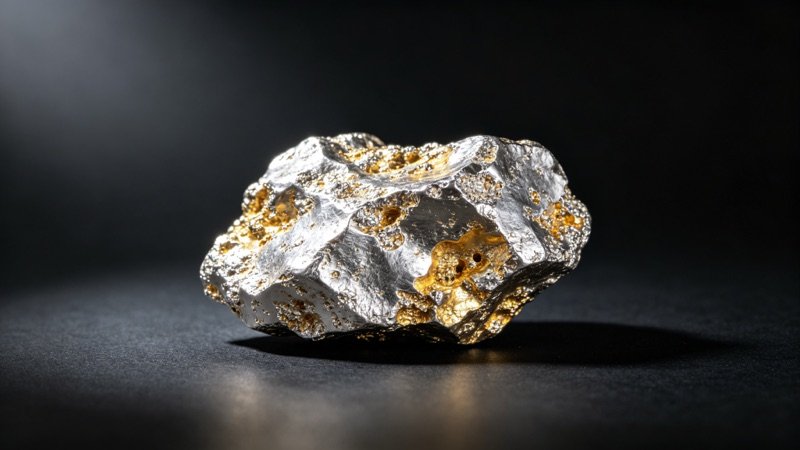
Platinum is a chemical element; it has symbol Pt and atomic number 78. It is a dense, malleable, ductile, highly unreactive, precious, silverish-white transition metal. Its name originates from Spanish platina, a diminutive of plata 'silver'. Platinum is a member of the platinum group of elements and group 10 of the periodic table. It has six naturally occurring isotopes. Platinum is used in catalytic converters, laboratory equipment, electrical contacts and electrodes, platinum resistance thermometers, dentistry equipment, and jewelry.

Transition Metal USGS 2025 silvery white
Atomic number 78Z
Atomic mass 195.085u
Valence e⁻ 1
Electron config. 1s2 2s2 2p6 3s2 3p6 4s2 3d10 4p6 5s2 4d10 5p6 6s1 4f14 5d9
Density
21.45g/cm³
Melting point
1768°C
Crustal abundance
0.005ppm
Annual production
190000
Recycling rate
90%(Low recycling rate (~25%); recovered from catalytic converters and jewelry)

Why This Element

Platinum is the most efficient catalyst for hydrogen oxidation and oxygen reduction — the core reactions in fuel cells that produce electricity with only water as the byproduct. Its ability to reversibly adsorb hydrogen also makes it essential to automotive catalytic converters and hydrogen purifiers.

Applications

CatalystsJewelryFuel cellsElectrodes

Applications in DepthElement & compound uses

Main Uses of the Element

Platinum is the foremost of the platinum-group metals: silvery-white, extremely ductile, strongly chemically inert and catalytically outstanding, carrying a dual identity of industry and luxury. Its largest industrial use is as a catalyst: in automotive three-way catalytic converters, platinum works together with palladium and rhodium to convert carbon monoxide, hydrocarbons and nitrogen oxides into harmless gases - the single largest outlet for platinum worldwide. In chemicals, platinum catalysts are used in nitric-acid manufacture (the ammonia-oxidation process), petroleum reforming, silicone-rubber crosslinking and the hydrogen-oxidation reaction in fuel cells. In new energy, platinum is the core catalyst in proton-exchange-membrane fuel-cell electrode assemblies, and the growth of the green-hydrogen industry has directly pulled on platinum demand. In jewelry, platinum has long been favored by the high-end market for its pure white color and resistance to tarnishing. In electronics and medicine, platinum is used in high-temperature electrical contacts, thermocouples, getters, prosthetic electrodes and pacemaker leads; in the lab, platinum crucibles, electrodes and resistance thermometers are standard equipment for precision analysis, and platinum is also an international reserve asset. It is precisely this dual identity of 'king of catalysis' and 'king of inertness' that keeps its position solid in automotive, energy and high-end manufacturing.

Key Compounds and Their Uses

Elemental platinum (Pt) is itself one of the most important application forms, used directly as platinum black, platinum gauze, platinum sponge and platinum targets in catalysts, electrodes and coatings. Platinum tetrachloride (PtCl4) is a basic halide of platinum, used to prepare other platinum compounds and platinum-plating baths. Cisplatin (cis-diamminedichloroplatinum, Pt(NH3)2Cl2) is one of the most successful chemotherapy drugs in history, with marked efficacy against testicular, ovarian, lung and bladder cancers and other solid tumors; it remains a cornerstone of oncological chemotherapy regimens, and its discovery is regarded as a milestone in metallopharmaceutics. Platinum dioxide (PtO2, Adams' catalyst) is a versatile catalyst commonly used in organic hydrogenation, reducing unsaturated bonds, nitro groups and carbonyl groups under mild conditions, and is widely used in pharmaceuticals and fine synthesis. In addition, chloroplatinic acid is a key intermediate for platinum plating and platinum refining, and platinum complexes are also used in certain next-generation anticancer drugs and OLED emissive materials.
Element History

Known to indigenous peoples of the Americas for centuries before European discovery in the 16th century. Distinguished from other metals in 1750. First isolated as pure metal in 1798. Commercial production began in 1865 from the Bushveld Complex. Today >80% of production comes from South Africa, Russia, and Zimbabwe. The London Platinum & Palladium Fix was established in 1989.

Alloys of this element (2)

View all alloys → Pt900 PtRh10

Related Elements

Sc · Scandium Ti · Titanium V · Vanadium Cr · Chromium Mn · Manganese Fe · Iron Co · Cobalt Ni · Nickel

Frequently Asked QuestionsLong-tail Q&A · data-driven

What is the melting point of Platinum?
1768 °C
What is the boiling point of Platinum?
3825 °C
What is the density of Platinum?
21.45 g/cm³
What are the atomic number and category of Platinum?
78 · Transition Metal
Which ore is Platinum mainly extracted from?
native platinum
What are the world reserves of Platinum?
81000000
What is the annual production of Platinum?
190000
What are the main uses of Platinum?
Platinum is the most efficient catalyst for hydrogen oxidation and oxygen reduction — the core reactions in fuel cells that produce electricity with only water as the byproduct. Its ability to reversibly adsorb hydrogen
Who discovered Platinum and when?
Antonio de Ulloa · 1735