Iron is the most widely used metal in today's industrial system: over 90% of all metallic material produced worldwide is iron-based, forming the backbone of modern society. From ore to steel, after blast-furnace ironmaking and converter steelmaking, rebar, sections and steel plates are used in huge quantities for the load-bearing structures of skyscrapers, bridges, subways, dams and tunnels; construction and infrastructure together consume roughly half of all steel each year. Transportation is another major steel consumer: car bodies and chassis, railway locomotives and wagons, the hulls of ocean-going ships, shipping containers and rails are almost all dominated by steel, and a single large cargo vessel can use tens of thousands of tonnes of it. In machinery manufacturing, the structural components of machine tools, construction machinery and agricultural equipment are mostly cast or alloy steel, while tool steels, bearing steels and die steels directly determine machining precision and service life. In energy and chemicals, wind-tower sections, photovoltaic mounting structures, nuclear reactor pressure vessels, oil and gas drilling platforms and long-distance pipelines rely on high-strength steel, and stainless steel underpins chemical, food and water-treatment equipment. Cast iron, valued for vibration damping, wear resistance and excellent castability, accounts for high-volume components such as machine-tool beds, engine cylinder blocks, manhole covers and radiators. The reason iron has become the premier structural metal is its high crustal abundance, mature smelting technology, a strength and toughness that can be adjusted over a wide range through alloying and heat treatment, and a cost far below that of other metals.
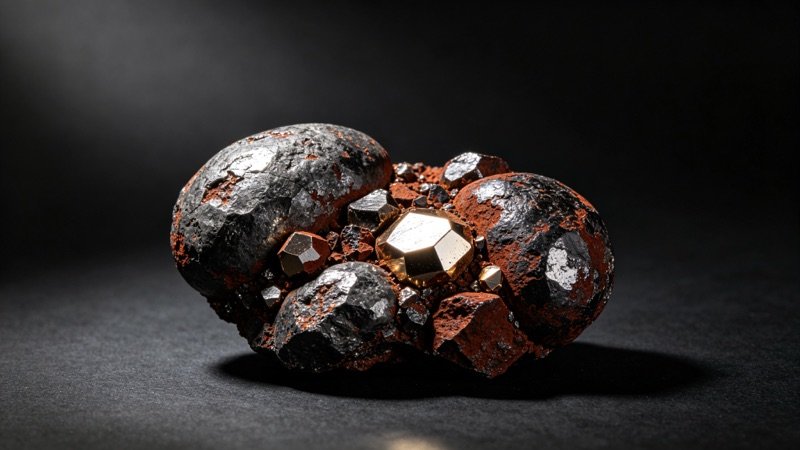
Iron(III) oxide (Fe2O3), i.e. hematite, is the dominant iron ore used in blast furnaces and, marketed as iron oxide red, is also the most widely used red inorganic pigment in paints, rubber, building materials and ceramic glazes. Iron(II,III) oxide (Fe3O4) is magnetite, another major iron ore; because of its strong magnetism, its powder is also used in magnetic-recording materials, magnetic-particle inspection and ferrite components. Iron disulfide (FeS2), commonly known as pyrite or 'fool's gold', is so named because its golden appearance is often mistaken for gold; historically it was widely used in the contact process for sulfuric acid, while today it is mostly recovered as a sulfur-bearing by-product of non-ferrous ores. Iron(III) chloride (FeCl3) is a flocculant widely used in drinking-water and wastewater treatment, and in the printed-circuit-board industry it etches copper foil and also participates in metal surface treatment.