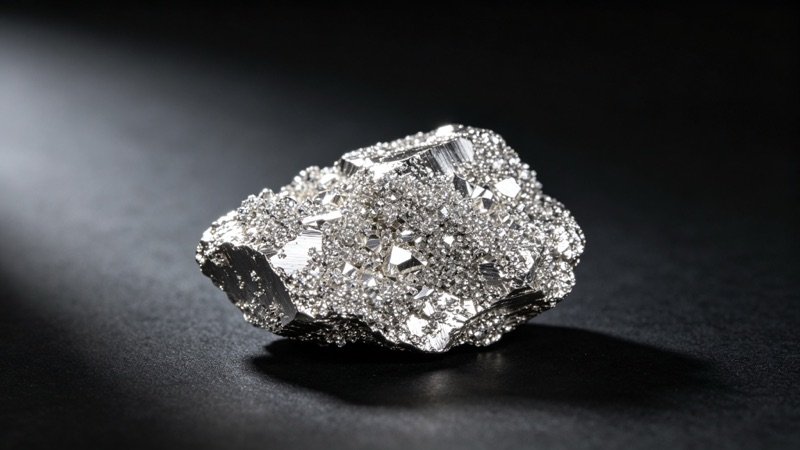
Iridium is the most corrosion-resistant member of the platinum-group metals and has the highest melting point among them; it is silvery-white, hard and brittle, extremely rare in the crust, and obtained almost entirely as a by-product of copper-nickel and platinum mining. Its most classic consumer use is in premium spark-plug electrodes - especially in aviation piston engines, high-performance racing and long-life industrial spark plugs - where the iridium electrode is extremely fine yet withstands ablation, giving stable ignition and a life far exceeding ordinary platinum electrodes. In high-temperature industry, iridium is used as the positive leg of thermocouples, capable of long-term temperature measurement above 1,600 degrees C in oxidizing atmospheres, making it a key sensor in glass melting and vacuum furnaces; it is also used in crucibles for single-crystal sapphire growth, fused-silica melting heaters and certain rocket-engine nozzles. In chemicals and pharmaceuticals, iridium complexes are important catalysts for asymmetric catalysis and organic synthesis, and are irreplaceable in the synthesis of certain chiral drugs and liquid-crystal materials. Iridium is also used in premium fountain-pen nibs, electrical contacts, reflective coatings for X-ray telescopes and certain phosphorescent OLED materials. Because of its high density, extremely high melting point and strong chemical inertness, iridium has almost no substitute in the combined service of extreme corrosion and extreme heat.
Iridium dioxide (IrO2) is the most commonly used oxide of iridium; it is electrically conductive like a metal and has excellent electrocatalytic performance, making it a core material for oxygen-evolution electrodes in water electrolysis, DSA dimensionally stable anodes and certain pH electrodes, and is also used in specialty resistor films. Iridium trichloride (IrCl3) is the most basic chloride precursor of iridium, an olive-green solid used to prepare various iridium complex catalysts, electroplating baths and OLED emissive materials. Chloroiridic acid (H2IrCl6) is the most important intermediate compound in iridium smelting and refining, a dark-brown solution that is the starting point for all iridium chemicals and iridium metal powder, as well as the feedstock for iridium catalysts and electrodeposited iridium layers. In addition, iridium acetylacetonate and iridium(III) tris(2-phenylpyridine) are used respectively in chemical vapor deposition and phosphorescent OLED emissive layers, and are key dopant materials in next-generation display technology.