Home/ Elements/ Au
Gold
Au 79

Gold

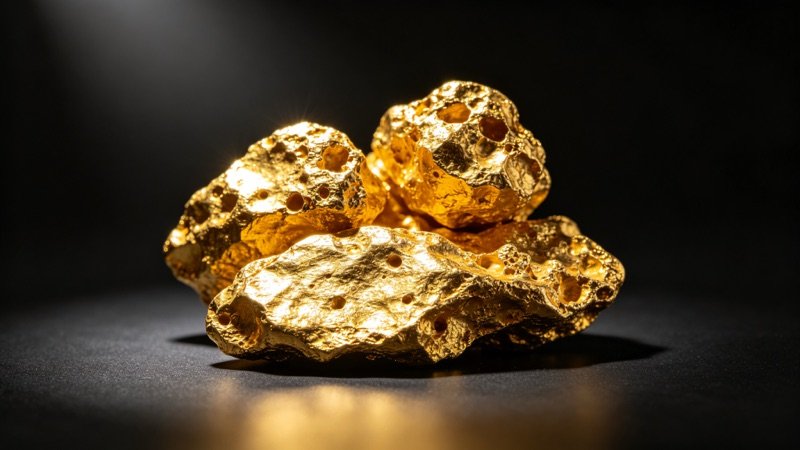
Gold is a chemical element; it has symbol Au (from Latin aurum) and atomic number 79. In its pure form, it is a bright, slightly orange-yellow, dense, soft, malleable, and ductile metal. Chemically, gold is a transition metal, a group 11 element, and one of the noble metals. Gold occurs naturally as nuggets or grains in rocks, in veins, and in alluvial deposits. Gold has been highly valued throughout history as a symbol of wealth and a store of value. It is also used in electronics (as a reliable conductor), dentistry, and as a catalyst.

Transition Metal USGS 2025 metallic yellow
Atomic number 79Z
Atomic mass 196.967u
Valence e⁻ 1
Electron config. 1s2 2s2 2p6 3s2 3p6 4s2 3d10 4p6 5s2 4d10 5p6 6s1 4f14 5d10
Density
19.3g/cm³
Melting point
1064°C
Crustal abundance
0.004ppm
Annual production
3300metric tons
Recycling rate
90%(Very high recycling rate (~90%); gold is highly valuable and widely recycled)

Why This Element

Gold is the most ductile and malleable of all metals (1 g can be drawn into a 3 km wire), chemically inert, resistant to corrosion, and has stable contact resistance — properties that make it irreplaceable for electronic connectors and bonding wires, while its perceived value drives jewelry and investment demand.

Applications

Jewelry
40%
Physical bars
24%
Central banks & institutions
21%
Coins & medals
7%
Electrical & electronic products
7%
Other
1%

Applications in DepthElement & compound uses

Main Uses of the Element

Gold is the metal humanity first recognized and has continuously cherished: golden-colored, highly corrosion-resistant, with excellent ductility and conductivity, it simultaneously plays monetary, jewelry and industrial roles. Jewelry remains the largest outlet for global gold consumption; from wedding rings and necklaces to gold bars and coins, gold's ornamental value and wealth-storage function run through thousands of years of civilization, and central banks worldwide have long used gold as the ballast of foreign-exchange reserves. In modern industry, gold's electrical contacts and coatings are irreplaceable - its contact resistance is extremely low and it never tarnishes, used in mobile-phone connectors, motherboard keypads, spacecraft switches and high-reliability relays; although a smartphone contains only milligrams of gold, almost every critical connector is gold-plated. In dentistry, gold alloys, with good biocompatibility, corrosion resistance and wear resistance, have long been used in porcelain-fused-to-metal crowns, inlays and orthodontic wires; although partly displaced by ceramics and new alloys, they remain in high-end restorations. Gold is also used in infrared-reflective coatings (architectural energy-saving glass, aircraft windshields), satellite thermal-control coatings, chemical catalysis (gold nanoparticles catalyzing carbon-monoxide oxidation) and high-precision wire bonding. Taking 'never rusts' to the extreme is the underlying logic by which gold has moved from currency into industry.

Key Compounds and Their Uses

Elemental gold (Au) is applied directly in forms such as gold leaf, gold powder, gold wire, gold plating and gold nanoparticles: gold leaf is used in traditional gilding and the decoration of temples and cultural relics; gold wire is used in high-end electronic wire bonding; and gold nanoparticles are widely used in biomedical diagnostics, immunochromatographic test strips and catalytic research. Gold trichloride (AuCl3) is the most basic gold compound, a red-brown crystal that is the starting material for all gold catalysts, gold-plating baths and gold nanoparticles, and also has a few traditional uses in red glass coloring and photographic toning. Gold(I) sulfide (Au2S) is the black sulfide of gold, used mainly historically in certain gilding processes and as a mineralogical specimen, with negligible modern industrial use. Beyond these, potassium gold cyanide is the main salt for industrial gold plating, chloroauric acid is used in electroless gold plating and gold-nanoparticle preparation, and gold complexes also carry academic value in certain anticancer-drug research and gold-catalyzed organic synthesis.
Element History

One of humanity's five oldest known metals (alongside copper, silver, lead, iron). Archaeological evidence shows gold objects date to 6000 BCE. Gold coinage began in Lydia around 600 BCE. Currently produced primarily as byproduct of copper mining; South Africa, China, and Australia are the largest producers.

Alloys of this element (10)

View all alloys → 18K 18K WG 14K PtIr10 AuCu Au9999 Pd950 Pt950Co

Related Elements

Sc · Scandium Ti · Titanium V · Vanadium Cr · Chromium Mn · Manganese Fe · Iron Co · Cobalt Ni · Nickel

Frequently Asked QuestionsLong-tail Q&A · data-driven

What is the melting point of Gold?
1064 °C
What is the boiling point of Gold?
2970 °C
What is the density of Gold?
19.3 g/cm³
What are the atomic number and category of Gold?
79 · Transition Metal
Which ore is Gold mainly extracted from?
native gold, electrum
What are the world reserves of Gold?
64000 metric tons
What is the annual production of Gold?
3300 metric tons
What are the main uses of Gold?
Gold is the most ductile and malleable of all metals (1 g can be drawn into a 3 km wire), chemically inert, resistant to corrosion, and has stable contact resistance — properties that make it irreplaceable for electronic
Who discovered Gold and when?
Middle East · Ancient (known since antiquity)