Home/ Elements/ Ag
Silver
Ag 47

Silver

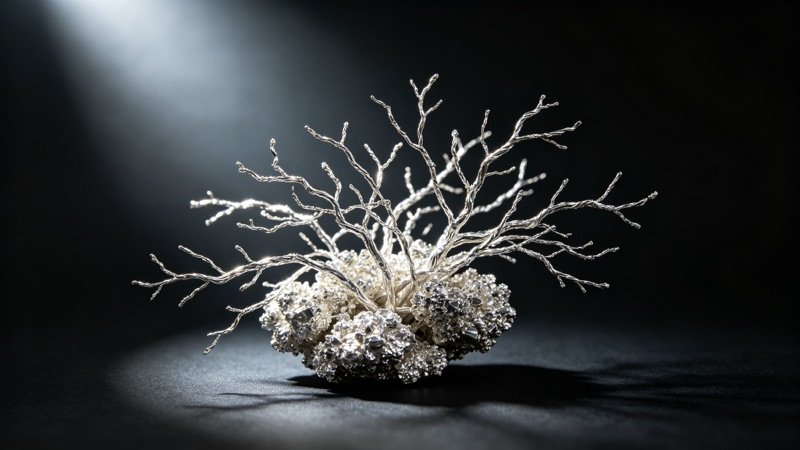
Silver is a chemical element; it has symbol Ag (from the Latin argentum, derived from the Proto-Indo-European h₂erǵ: 'shiny' or 'white') and atomic number 47. A soft, white, lustrous transition metal, it exhibits the highest electrical conductivity, thermal conductivity, and reflectivity of any metal. The metal is found in the Earth's crust in the pure, free elemental form ('native silver'), as an alloy with gold and other metals, and in minerals such as argentite and chlorargyrite. Silver has been used for thousands of years as a precious metal for jewelry, currency, and tableware. Modern uses include electronics, photography, and water purification.

Transition Metal USGS 2025 lustrous white metal
Atomic number 47Z
Atomic mass 107.868u
Valence e⁻ 1
Electron config. 1s2 2s2 2p6 3s2 3p6 4s2 3d10 4p6 5s1 4d10
Density
10.49g/cm³
Melting point
962°C
Crustal abundance
0.075ppm
Annual production
25000metric tons
Recycling rate
80%(Moderate recycling rate (~30%); silver recovered from jewelry, electronics, and X-ray film)

Why This Element

Silver has the highest electrical and thermal conductivity of any metal, combined with high reflectivity and natural antimicrobial properties. Its industrial value stems from four irreplaceable uses: electrical conductors (solar panels, microelectronics), solders and brazing alloys, antimicrobial coatings, and photographic materials (though digital photography has reduced this end-use significantly).

Applications

Electrical & electronic products
25%
Other industrial & photographic
19%
Physical investment (bars)
18%
Photovoltaics
15%
Coins & medals
14%
Jewelry & silverware
6%
Brazing & solder
3%

Applications in DepthElement & compound uses

Main Uses of the Element

Silver is one of the earliest metals used by humanity; today it is far more than jewelry and money—it is a critical material consumed heavily by industry. Electrical and electronic engineering is silver's largest industrial outlet: silver ranks first among all metals in both electrical and thermal conductivity, and silver pastes, silver contacts, or silver sintered layers appear in switches, relays, circuit breakers, photovoltaic cell grid lines, touchscreens, and flexible electronic circuits. Demand for silver contacts in high-voltage connectors, IGBT modules, and charging-pile contactors for electric vehicles has risen rapidly in recent years, and the photovoltaic industry has pushed silver-paste consumption to record highs. Although photographic film and paper have declined, in the film era silver halide light-sensitive materials were silver's second-largest use; today only motion-picture film, medical X-ray film, and professional photography carry it on. Jewelry, silverware, silver coins, and commemorative silver coins still steadily absorb a considerable share of silver, and sterling silver (925) is the most common jewelry alloy standard. Antibacterial action is another special niche for silver: silver ions inhibit bacterial growth, so silver is added to hospital dressings, antibacterial coatings in refrigerators and washing machines, water-purifier filters, food packaging, and baby-bottle linings.

Key Compounds and Their Uses

Silver nitrate (AgNO3) is the most basic silver salt—a colorless, transparent crystal readily soluble in water. It is the starting point for preparing other silver compounds, silver-plating baths, and the silver mirror reaction, and historically was also used for eye drops in newborns to prevent gonococcal infection. Silver chloride (AgCl) decomposes under light to metallic silver and is one of the main constituents of the light-sensitive emulsion in photographic film and paper; it is still used in X-ray film, photographic paper, and certain ion-selective electrodes. Silver bromide (AgBr) has even higher photographic sensitivity and is the principal light-sensitive material of traditional camera film and graphic-arts film; the emulsion layer of color film is still based on it. Silver sulfide (Ag2S) is what causes silverware to tarnish and darken—a thin black layer formed when trace hydrogen sulfide in the air reacts with silver; it is also used as an infrared optical material and a solid electrolyte, and appears in certain sulfide solid-state batteries.
Element History

One of the five metals known to antiquity (alongside copper, gold, lead, iron). Archaeological evidence shows silver mining in Anatolia and the Aegean dating to 5000 BCE. Silver was the primary monetary metal of classical Greece and Rome. The discovery of the Americas dramatically increased global silver supply starting in the 16th century. Today approximately 70% of production is byproduct of copper, lead, and zinc mining.

Alloys of this element (2)

View all alloys → 925Ag BAg-35

Related Elements

Sc · Scandium Ti · Titanium V · Vanadium Cr · Chromium Mn · Manganese Fe · Iron Co · Cobalt Ni · Nickel

Frequently Asked QuestionsLong-tail Q&A · data-driven

What is the melting point of Silver?
962 °C
What is the boiling point of Silver?
2162 °C
What is the density of Silver?
10.49 g/cm³
What are the atomic number and category of Silver?
47 · Transition Metal
Which ore is Silver mainly extracted from?
argentite, acanthite
What are the world reserves of Silver?
640000 metric tons
What is the annual production of Silver?
25000 metric tons
What are the main uses of Silver?
Silver has the highest electrical and thermal conductivity of any metal, combined with high reflectivity and natural antimicrobial properties. Its industrial value stems from four irreplaceable uses: electrical conductor
Who discovered Silver and when?
unknown, before 5000 BC · Ancient (known since antiquity)