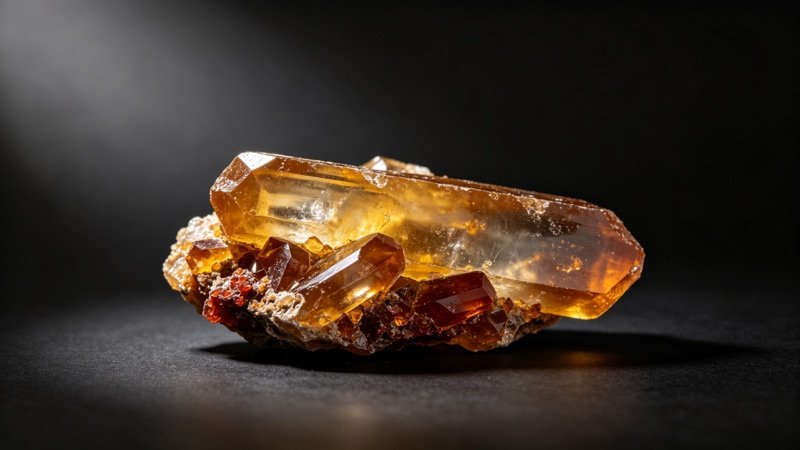
Yttrium is one of the more widely distributed rare-earth elements; although classified as a rare earth, it occupies irreplaceable positions in luminescence, ceramics and superconductivity. Its central role in white LEDs is as a yellow phosphor: cerium-doped yttrium aluminum garnet (YAG:Ce) absorbs the blue light emitted by a blue chip and converts it to yellow, which mixes with the remaining blue to produce white LED lighting—the mainstream energy-efficient lighting scheme today. In ceramics, yttria-stabilized zirconia (YSZ) uses yttrium oxide to stabilize the zirconia crystal form, producing high-strength, high-toughness structural ceramics used in artificial joints, cutting tools and solid-oxide fuel-cell electrolytes. In superconductivity, yttrium barium copper oxide (YBCO) is an important high-temperature superconductor that operates at liquid-nitrogen temperatures, used in R&D on superconducting cables, maglev and superconducting fault-current limiters. Yttrium is also used in specialty glasses, automotive exhaust catalysts and neutron-absorbing materials for nuclear reactors.
Yttrium oxide (Y2O3) is the main yttrium compound, used as an additive in rare-earth luminescent materials and structural ceramics, and also as a decolorizer and dopant in optical glass. Yttrium chloride (YCl3) is an intermediate for preparing metallic yttrium and other yttrium compounds, and is also used in catalysts and organic-synthesis research. Yttrium barium copper oxide (YBa2Cu3O7, or YBCO) is the representative high-temperature superconductor operating at liquid-nitrogen temperatures, used in superconducting thin films, tapes and strong-magnet research, and is the core material for engineering high-temperature superconductivity. Yttrium aluminum garnet (YAG), i.e. Y3Al5O12, is the host material for the yellow phosphor in white LEDs when doped with cerium; when doped with neodymium it forms the Nd:YAG laser crystal, widely used in industrial, medical and research lasers.