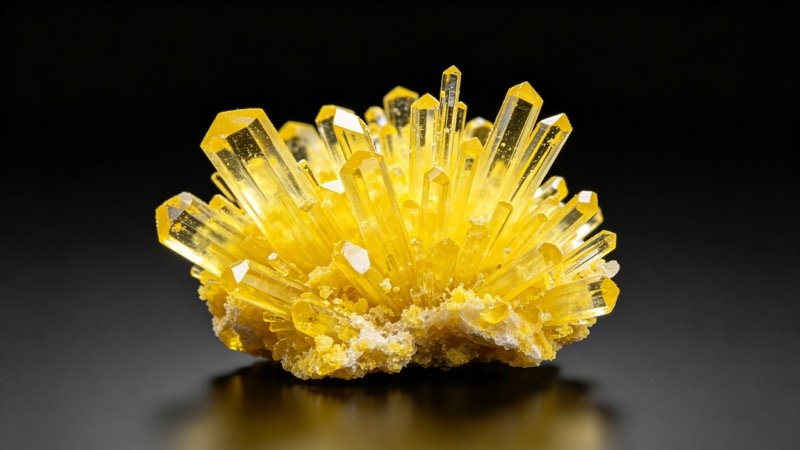
Sulfur is the starting material of sulfuric acid, the “mother of chemicals” of modern industry. Elemental sulfur itself is used in limited quantities, but almost all of it is converted into sulfuric acid before flowing into every corner of industry. Sulfur is roasted or recovered from smelter off-gas to produce sulfuric acid, known as the mother of chemicals and a foundational feedstock for fertilizers, metallurgy, petrochemicals, and light industry. Vulcanization is sulfur's most iconic application: after sulfur is added to natural or synthetic rubber, sulfur atoms form cross-links between polymer chains, turning sticky, soft raw rubber into elastic, wear-resistant, heat-resistant vulcanized rubber; tires, hoses, seals, and shoe soles all depend on this process. In civilian use, sulfur goes into black powder and fireworks, as well as wood preservation, soil amendment, and pesticide fungicides. Historically it also entered sulfuric acid, sulfur soap, and traditional medicine.
Sulfuric acid H2SO4 is one of the highest-volume chemical products, used to make phosphate and nitrogen fertilizers, as a refining catalyst in the petroleum industry, for pickling steel and extracting uranium and copper in metallurgy, and as the electrolyte in lead-acid batteries. Iron disulfide FeS2 is pyrite, nicknamed fool's gold, traditionally the main ore for making sulfuric acid; modern practice mostly recovers sulfur from smelter off-gas. Sulfur dioxide SO2, produced by burning sulfur or roasting pyrite, is used to make sulfites, pulp bleaching, food preservation, and wine stabilization, and is also a major air pollutant. Sodium thiosulfate Na2S2O3, commonly called hypo, is widely used in photographic fixing and in iodometric chemical analysis. Calcium sulfate CaSO4 is gypsum, used in building boards, as a cement set retarder, and as a coagulant in tofu making. Hydrogen sulfide H2S is used in natural gas sweetening and chemical analysis.