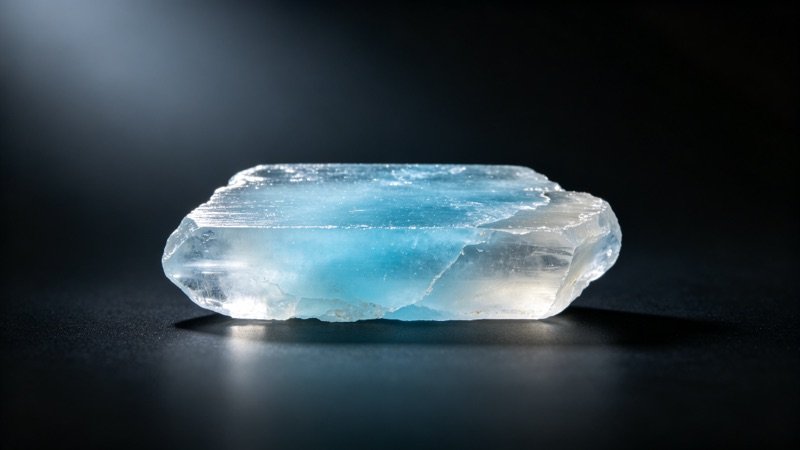
Strontium is an alkaline-earth metal with few uses in its elemental form, but its salts and compounds have distinctive applications in luminescence, magnetism and optoelectronics. Its oldest civilian use is in fireworks and signal flares: strontium salts burn with a vivid scarlet flame and are the primary red colorant in fireworks and in railway and maritime red signal flares. In magnets, strontium ferrite ('strontium magnets') are a class of low-cost permanent magnets widely used in refrigerator magnets, loudspeakers, DC motors and automotive sensors, offering excellent value and resisting demagnetization. In LEDs and phosphors, europium-doped strontium aluminate is a long-afterglow luminous material that charges in daylight and glows at night, used for fire-safety signs, luminous dials and safety indicators. In ophthalmics, certain strontium salts serve as contrast agents in eye examinations and as desensitizing ingredients in toothpaste. Strontium-90 is a radioactive isotope once used in nuclear batteries and radiotherapy, but has gradually been phased out under strict radiation controls.
Strontium carbonate (SrCO3) is the most important strontium compound, used as a red colorant in fireworks and as a fining agent in LCD glass substrates, and is the starting point for producing other strontium salts. Strontium chloride (SrCl2) provides the red color in fireworks and signal flares and, as an electrolyte supplement in medicinal toothpaste, relieves dentine hypersensitivity. Strontium titanate (SrTiO3) is a high-dielectric-constant electronic ceramic used in multilayer ceramic capacitors and grain-boundary-layer capacitors, and also as a synthetic gemstone and optical prism. Strontium aluminate (SrAl2O4), when doped with europium and dysprosium, is a high-efficiency long-afterglow luminescent material whose charge-holding time and brightness far exceed traditional zinc sulfide phosphors, and is already used in fire-evacuation signs and luminous coatings.