Home/ Elements/ Rh
Rhodium
Rh 45

Rhodium

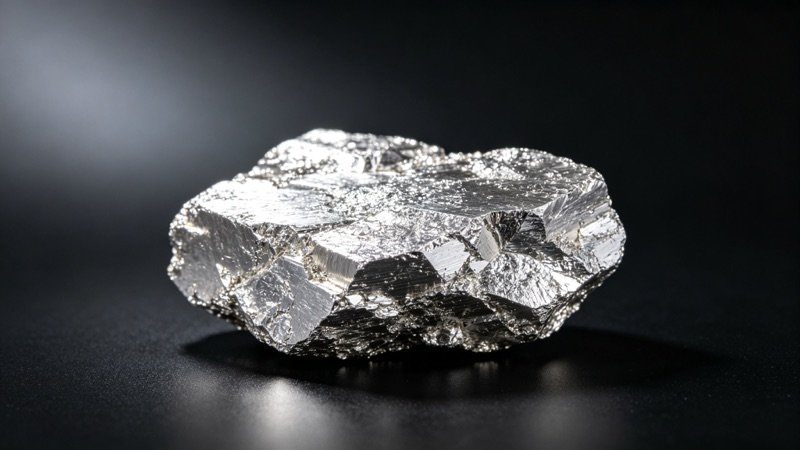
Rhodium is a chemical element; it has symbol Rh and atomic number 45. It is a very rare, silvery-white, hard, corrosion-resistant transition metal. It is a noble metal and a member of the platinum group. It has only one naturally occurring isotope: rhodium-103. Natural rhodium consists entirely of stable isotopes. Rhodium is used primarily as one of the hard and durable metals for alloys and in catalytic converters for automobiles. Due to its rarity and high price, it is also used as a symbol of wealth, being rarer than gold.

Transition Metal USGS 2025 silvery white metallic
Atomic number 45Z
Atomic mass 102.906u
Valence e⁻ 1
Electron config. 1s2 2s2 2p6 3s2 3p6 4s2 3d10 4p6 5s1 4d8
Density
12.41g/cm³
Melting point
1964°C
Crustal abundance
0.001ppm
Annual production
21tonnes Rh
Recycling rate
60%(Very low recycling rate; PGM recovered from spent catalytic converters)

Why This Element

Rhodium is the rarest and most expensive platinum group metal — more costly per troy ounce than gold. Its unique combination of excellent catalytic activity (especially for automotive emissions control), superior electrical conductivity, and bright metallic luster makes it irreplaceable in three-way catalytic converters and reflective coatings.

Applications

Automotive catalystsThermocouplesCoatings

Applications in DepthElement & compound uses

Main Uses of the Element

Rhodium is the scarcest and most price-volatile of the platinum-group metals; global annual production is measured in tonnes and comes almost entirely as a by-product recovered from copper-nickel ores. Its most unassailable position is in automotive three-way catalytic converters: rhodium has a unique ability to reduce nitrogen oxides in exhaust, converting NOx into nitrogen and oxygen over a wide temperature window, while palladium and platinum are better at handling carbon monoxide and hydrocarbons; the three together form the active coating of the modern gasoline-vehicle three-way catalyst. As long as cars are still driven by internal combustion engines and must meet emissions regulations, this demand for rhodium is hard to displace. Besides automobiles, rhodium's high melting point, chemical stability, and good reflectivity make it suitable for high-precision thermocouples (platinum-rhodium thermocouples), which can measure temperatures continuously in furnaces and glass tanks above 1000 °C. It is also electroplated at very low current densities onto electrical contacts, waveguides, and optical mirrors to produce hard layers with stable contact resistance and resistance to sulfidation, used in aerospace connectors, relays, and mirrors. In chemicals, rhodium complexes are the core catalysts for oxo synthesis (hydroformylation) of olefins, which yields aldehyde intermediates on the way to plasticizer alcohols such as 2-ethylhexanol.

Key Compounds and Their Uses

Rhodium trichloride (RhCl3, usually sold as the trihydrate) is the most important starting material in rhodium chemistry—a reddish-brown crystal from which nearly all rhodium catalysts and rhodium plating baths are prepared; when supported on alumina it becomes a hydrogenation catalyst. Rhodium sesquioxide (Rh2O3) is a higher oxide of rhodium, a black solid used mainly in the electronics industry for thick-film resistor pastes and electrode materials, and also as a support coating in certain catalytic reactions. Wilkinson's catalyst (tris(triphenylphosphine)rhodium(I) chloride, RhCl(PPh3)3) is one of the most famous homogeneous hydrogenation catalysts in organometallic chemistry. A yellow crystal, it selectively hydrogenates alkenes to alkanes under mild conditions without affecting other functional groups, and is widely used in fine chemicals, pharmaceuticals, and organic-synthesis laboratories.
Element History

Discovered in 1803 by William Hyde Wollaston, who isolated it from crude platinum ore from South America — simultaneously discovering palladium in the same work. Wollaston demonstrated rhodium's distinct properties including its characteristic rose-pink compounds. Currently recovered as a byproduct of nickel-copper mining, with over 80% of production from South Africa's Bushveld Complex.

Related Elements

Sc · Scandium Ti · Titanium V · Vanadium Cr · Chromium Mn · Manganese Fe · Iron Co · Cobalt Ni · Nickel

Frequently Asked QuestionsLong-tail Q&A · data-driven

What is the melting point of Rhodium?
1964 °C
What is the boiling point of Rhodium?
3695 °C
What is the density of Rhodium?
12.41 g/cm³
What are the atomic number and category of Rhodium?
45 · Transition Metal
Which ore is Rhodium mainly extracted from?
Platinum-group minerals
What are the world reserves of Rhodium?
3000 tonnes
What is the annual production of Rhodium?
21 tonnes Rh
What are the main uses of Rhodium?
Rhodium is the rarest and most expensive platinum group metal — more costly per troy ounce than gold. Its unique combination of excellent catalytic activity (especially for automotive emissions control), superior electri
Who discovered Rhodium and when?
William Hyde Wollaston · 1803