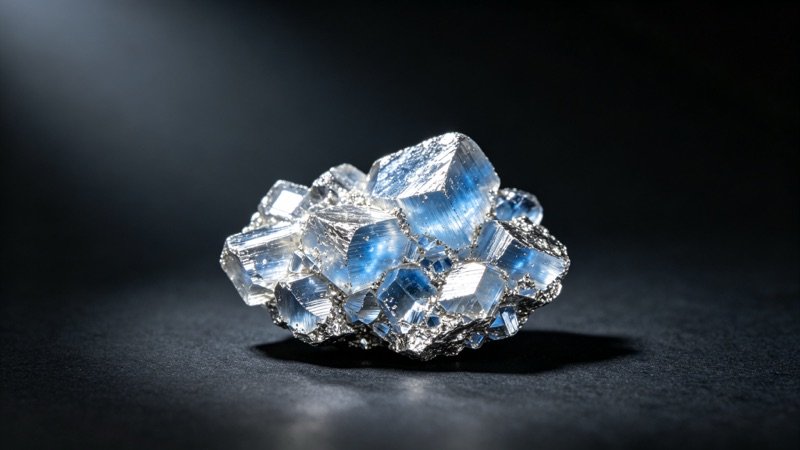
Osmium is one of the densest stable metals, blue-gray, hard and brittle; at room temperature it slowly oxidizes in air to toxic osmium-tetroxide vapor, so it is rarely used directly as the pure metal. Its most classic use is in ultra-hard osmium alloys with iridium and ruthenium, used for the ball of fountain-pen nibs, bearings in mechanical watches, instrument pivots and compass bearings - the so-called 'iridium-tipped' fountain pens often actually contain an osmium-iridium alloy that writes for decades without wear. Industrially, osmium alloys are also used in electrical contacts, phonograph styli and critical friction parts of precision instruments. Because pure osmium is brittle, oxidizes readily and is excessively dense, its use has shrunk over time, with most applications displaced by more stable iridium, ruthenium, tungsten carbide and structural ceramics. Where osmium has truly left its mark in modern technology is in its oxides as organic-synthesis catalysts and as stains for biological electron microscopy, plus its research value in a few highly selective reactions. It is also one of the rarest stable elements in the crust, with annual output measured in kilograms - a classic case of a metal famous in history but superseded in modern use.
Osmium tetroxide (OsO4) is osmium's best-known and most dangerous compound, a white crystal that is highly volatile with a highly toxic vapor that strongly irritates the cornea. In organic synthesis it is an extraordinarily important reagent for cis-dihydroxylation, converting alkenes into vicinal diols, widely used in pharmaceutical and fine-chemical synthesis; in biology it is the classic fixative and stain for transmission-electron-microscope samples, strongly staining the lipid bilayer of cell membranes so that ultrathin sections image clearly under the microscope - a use still irreplaceable today. Osmium trichloride (OsCl3) is the most commonly used chloride precursor of osmium, used to prepare other osmium complexes and catalysts. Osmium dioxide (OsO2) is the black oxide of osmium, used in small quantities mainly in electrode materials and catalytic research. Because osmium itself is produced in tiny quantities, nearly all of its compounds serve laboratory research and high-end fine synthesis, and do not enter mass consumer products.