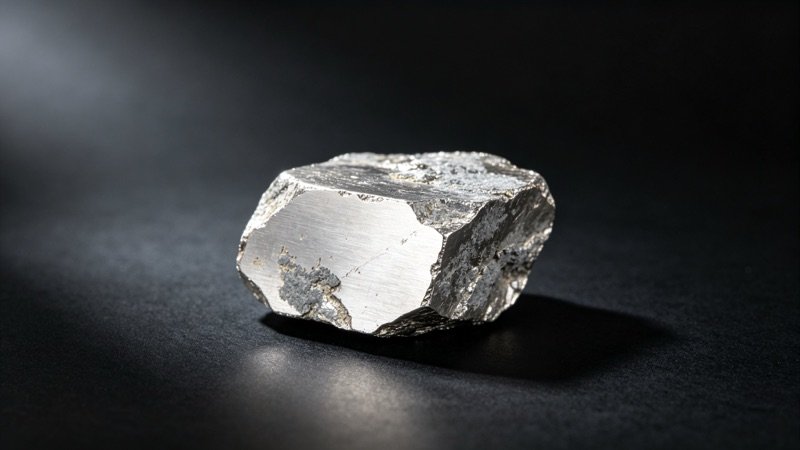
Erbium is a key element underpinning modern fiber-optic communications. The erbium-doped fiber amplifier (EDFA) exploits stimulated emission of erbium ions at the 1550 nm communications window to directly attenuate-and-amplify the optical signal within the fiber link itself, eliminating the traditional optical-electrical-optical repeater; it is precisely this amplifier that has made the low-cost laying of transoceanic fiber backbones and submarine cables possible. In lasers, erbium-doped glass lasers emit near-infrared light around 1.54 µm; this wavelength is eye-safe, making it suitable for laser ranging, environmental monitoring, and military eye-safe lasers. Erbium is also a classic glass colorant: erbium oxide imparts a soft pink hue to glass and porcelain, used in imitation-ruby glass, colored art glass, and tableware glazes. In metallurgy, small additions of erbium act as deoxidizers and grain refiners in titanium and vanadium alloys, improving their high-temperature properties.
Er2O3 (erbium(III) oxide) is the principal oxide of erbium. It is a pink powder and the core raw material for preparing erbium-doped fibers, laser glasses, and pink glass colorants; it is also used in ceramic glazes and as an electronic-ceramic additive. ErCl3 (erbium trichloride) is an intermediate in the extraction and separation flowsheet, used for the electrolytic production of erbium metal and the synthesis of erbium organometallic precursors. Er:glass is erbium-doped glass, in which a few thousandths of trivalent erbium ions are uniformly incorporated into a silicate or fluorophosphate glass matrix; it is both the core material of fiber amplifiers and the working medium of eye-safe lasers. Its ability to amplify the 1550 nm optical signal relies precisely on the unique atomic properties of the erbium ion: a long metastable level and a suitable stimulated-emission cross-section.