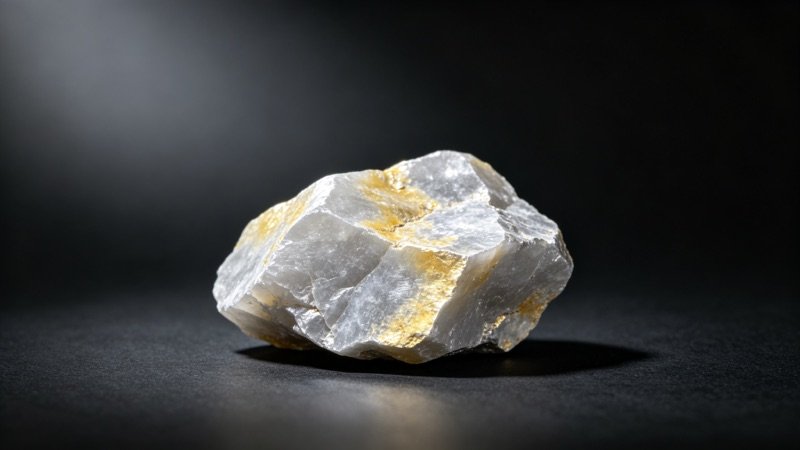
Praseodymium is a highly reactive member of the light rare-earth family. The pure metal itself is rarely used on its own; the vast majority enters materials industry in the form of mischmetal or rare-earth alloys. In NdFeB permanent magnets, praseodymium is commonly added as a partial substitute for neodymium. On the industrial scale, praseodymium and neodymium are co-electrolyzed into a Pr-Nd metal as the feedstock for magnets, an approach that lowers cost while improving the temperature stability and demagnetization resistance of the magnets without any significant loss in maximum energy product. Adding a small amount of praseodymium to magnesium-aluminum alloys refines the grain structure and raises high-temperature strength and creep resistance, making these alloys suitable for aero-engine components and racing wheel hubs and other applications that demand light weight and heat resistance. Pr-Nd glass, made from praseodymium together with neodymium, strongly absorbs the sodium yellow line and infrared radiation, and has long been the standard lens material for welding and glassblower goggles. Praseodymium is also one of the constituent elements of the hydrogen-storage alloys used in nickel-metal hydride batteries and of petroleum fluid catalytic cracking catalysts.
Pr6O11 (praseodymium oxide; in practice the industry commonly refers to it under the name praseodymium(III) oxide, Pr2O3) is the principal oxide of praseodymium. It is a deep blue-green powder obtained by calcining praseodymium oxalate or nitrate. It is the core raw material for the praseodymium yellow colorants used in glass and ceramics; when added to glass it yields a fresh lemon-green or apple-green hue, and it is also used in ceramic glazes and colored optical lenses. Mixed with cerium and neodymium oxides, it is a main component of the precision polishing powders used for optical glass and liquid-crystal substrates, whose moderate hardness lets them polish lens and LCD-substrate surfaces to nanometer-level smoothness. Praseodymium oxide also serves as one component of the mixed rare-earth additives used in petroleum fluid catalytic cracking. PrCl3 (praseodymium trichloride) is an intermediate product of hydrometallurgy, used mainly for the electrolytic production of praseodymium metal and Pr-Nd alloy; it is also the starting point in research for preparing other praseodymium compounds and catalysts, and does not itself enter consumer products.