Home/ Elements/ Tc
Technetium
Tc 43

Technetium

Technetium is a chemical element; it has symbol Tc and atomic number 43. It is the lightest element whose isotopes are all radioactive. Technetium is one of only two radioactive elements both preceded and succeeded in the periodic table by elements with stable forms, the other being promethium. Nearly all technetium is produced synthetically, and only minute amounts are found in Earth's crust due to spontaneous fission of uranium ores. Technetium-99m is widely used in medical imaging as a radioactive tracer.

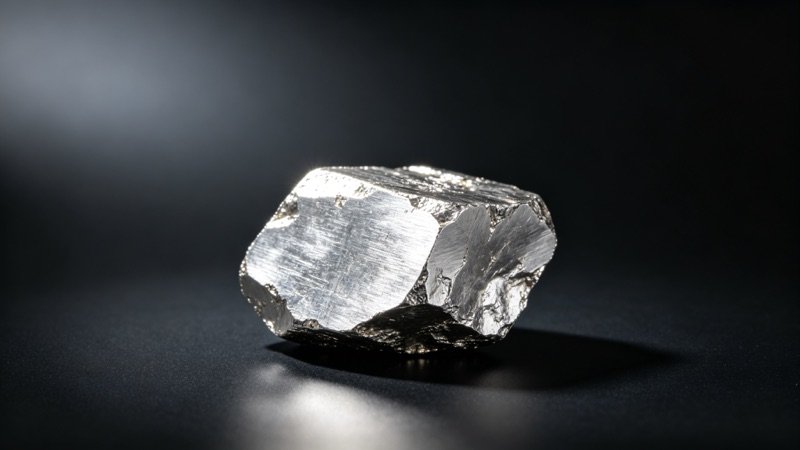
Transition Metal shiny gray metal
Atomic number 43Z
Atomic mass 98u
Valence e⁻ 2
Electron config. 1s2 2s2 2p6 3s2 3p6 4s2 3d10 4p6 5s2 4d5
Density
11.0g/cm³
Melting point
2157°C
Crustal abundance
3e-10ppm
Annual production
Recycling rate
Medical use; short half-life

Why This Element

Technetium is the only element with no stable isotopes — the lightest such element. Despite its artificial origin, it finds widespread medical use as Tc-99m, the most commonly used radiotracer in nuclear medicine imaging. Technetium-99 acts as an excellent corrosion inhibitor for steel and serves as an alloying addition.

Applications

Medical imaging (Tc-99m)

Applications in DepthElement & compound uses

Main Uses of the Element

Technetium was the first synthetic radioactive element, occurring in nature only in trace amounts as a fission product of uranium ores; it therefore has no traditional metallurgical, structural, or civilian industrial uses. Its real, and today almost its only, large-scale application lies in nuclear medicine. Technetium-99m is the most widely used medical radioisotope in hospitals worldwide, employed in bone scans and in myocardial perfusion, thyroid, renal, brain, and tumor imaging. A technetium-99m-labeled drug is injected intravenously, and a gamma camera or SPECT system acquires images that reveal tumor metastases, the extent of a myocardial infarction, renal function, and bone lesions. Tc-99m has a half-life of about six hours and a gamma-ray energy well matched to imaging—enough to penetrate the body for detection without exposing the patient to excessive radiation—and these are the fundamental reasons it has become the workhorse nuclide of nuclear medicine. Beyond medical imaging, metallic technetium and its alloys have no large-scale industrial consumption. It has respectable corrosion resistance and could in principle serve as a special alloy additive, but its high price and radioactivity have kept it out of the materials market; within the nuclear industry it is studied only as an object of spent-fuel reprocessing and of long-term behavior studies of high-level radioactive waste.

Key Compounds and Their Uses

Technetium dioxide (TcO2) is one of the most stable oxides of technetium, a black or gray powder studied mainly as a chemical form of technetium in nuclear-fuel reprocessing and in immobilization research on high-level waste; it currently has no civilian products. Ammonium pertechnetate (NH4TcO4), which resembles potassium perchlorate in appearance, is the most important intermediate in technetium chemistry. It is obtained by dissolving irradiated targets, followed by solvent extraction and crystallization, and serves as the feedstock for preparing other technetium compounds and Tc-99m medical generators. What is actually injected into the patient in the clinic is Tc-99m pertechnetate (the pertechnetate anion, TcO4-), eluted from a molybdenum-99 generator; combined with various cold kits such as methylenediphosphonate, methoxyisobutylisonitrile, and diethylenetriaminepentaacetic acid, it forms complete sets of radiopharmaceuticals for bone, myocardial, and dynamic renal imaging.
Element History

Discovered in 1937 by Carlo Perrier and Emilio Segrè while analyzing molybdenum foil bombarded with deuterons in the Berkeley cyclotron. First element discovered by artificial means rather than natural occurrence. The longest-lived isotope (Tc-98) has a half-life of 4.2 million years, ensuring all primordial technetium has decayed. Currently produced in nuclear reactors via fission of uranium-235.

Related Elements

Sc · Scandium Ti · Titanium V · Vanadium Cr · Chromium Mn · Manganese Fe · Iron Co · Cobalt Ni · Nickel

Frequently Asked QuestionsLong-tail Q&A · data-driven

What is the melting point of Technetium?
2157 °C
What is the boiling point of Technetium?
4265 °C
What is the density of Technetium?
11.0 g/cm³
What are the atomic number and category of Technetium?
43 · Transition Metal
Which ore is Technetium mainly extracted from?
None (synthetic)
What are the main uses of Technetium?
Technetium is the only element with no stable isotopes — the lightest such element. Despite its artificial origin, it finds widespread medical use as Tc-99m, the most commonly used radiotracer in nuclear medicine imaging
Who discovered Technetium and when?
Emilio Segrè · 1937