Home/ Elements/ Tb
Terbium
Tb 65

Terbium

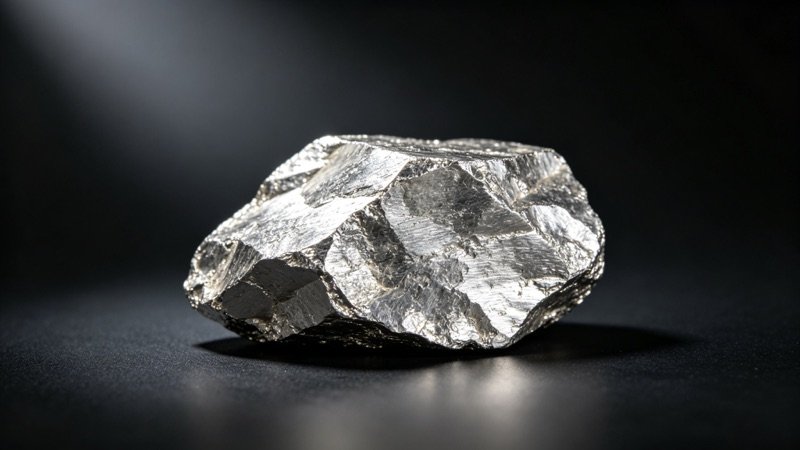
Terbium is a chemical element; it has symbol Tb and atomic number 65. It is a silvery-white, rare earth metal that is malleable, ductile, and soft enough to be cut with a knife. The ninth member of the lanthanide series, terbium is a fairly electropositive metal that reacts with water, evolving hydrogen gas. Terbium was discovered in 1843 by Swedish chemist Carl Gustaf Mosander as a component of yttria. Terbium compounds are used in green phosphors in color television picture tubes, solid-state devices, and lasers.

Lanthanide USGS 2025 silvery white
Atomic number 65Z
Atomic mass 158.925u
Valence e⁻ 2
Electron config. 1s2 2s2 2p6 3s2 3p6 4s2 3d10 4p6 5s2 4d10 5p6 6s2 4f9
Density
8.23g/cm³
Melting point
1356°C
Crustal abundance
1.2ppm
Annual production
200tonnes REO
Recycling rate
1%(Low recycling rate; recovered from phosphors and lighting)

Why This Element

Terbium is the rarest of the light lanthanides. Its primary industrial value stems from terbium-doped green phosphors that produce the ideal green emission for color TV and LED displays — an irreplaceable component where substitute materials have failed to match its color purity and brightness.

Applications

Green phosphorsMagnetostrictive alloys

Applications in DepthElement & compound uses

Main Uses of the Element

Terbium is a heavy rare earth used in very small quantities but playing a key role, mainly in two classes of high-tech materials: phosphors and magnetostrictive alloys. Under cathode-ray and ultraviolet excitation, trivalent terbium emits an extremely pure green light, which is why it is the activator of the green component in trichromatic phosphors, energy-saving lamp tubes, and white LEDs; without it, high-color-rendering white light cannot be achieved. The Tb-Dy-Fe alloy Terfenol-D is the commercial material with the strongest room-temperature magnetostrictive effect: under an applied magnetic field it elongates or contracts with precise control, and is used to make sonar transducers, ultrasonic machining vibrators, precision displacement actuators, and fuel injectors. In magneto-optical disks (TbFeCo amorphous alloy), terbium provides the perpendicular magnetization required by the magneto-optical Kerr effect, and was once the recording medium of rewritable optical disks. In NdFeB magnets it likewise raises high-temperature coercivity and is one of the essential additive elements in the high-end magnets used in new-energy vehicle motors.

Key Compounds and Their Uses

Tb4O7 (usually metered as terbium(III) oxide, Tb2O3) is the principal industrial oxide of terbium. It is a brownish powder and the starting point for preparing green phosphors, magnetostrictive alloys, and terbium metal. TbCl3 (terbium trichloride) is an intermediate in the extraction and separation flowsheet, used for the molten-salt electrolytic production of terbium metal and the synthesis of other terbium compounds. Tb-Dy alloys are commonly used in the form of Tb-Dy-Fe (TbxDy1-xFe2), the magnetostrictive material sold under the trade name Terfenol-D; in a magnetic field it produces strain several times larger than that of ordinary ferromagnetic materials, and is the core of sonar, ultrasonic transducers, and precision actuators. Together with the terbium activation center in the Gd2O2S:Tb scintillator screen, it embodies the unique dual capability of the terbium ion: it both luminesces and deforms under a magnetic field.
Element History

Discovered in 1843 by Carl Gustaf Mosander while fractionating the yttrium earth — he separated it into three fractions: yttrium, terbium, and erbium. The discovery was initially questioned because Mosander's methods were considered too crude. Isolated as pure metal in 1905. Currently recovered from bastnäsite and monazite ores.

Related Elements

La · Lanthanum Ce · Cerium Pr · Praseodymium Nd · Neodymium Pm · Promethium Sm · Samarium Eu · Europium Gd · Gadolinium

Frequently Asked QuestionsLong-tail Q&A · data-driven

What is the melting point of Terbium?
1356 °C
What is the boiling point of Terbium?
3123 °C
What is the density of Terbium?
8.23 g/cm³
What are the atomic number and category of Terbium?
65 · Lanthanide
Which ore is Terbium mainly extracted from?
bastnäsite, monazite
What are the world reserves of Terbium?
6000000 tonnes REO
What is the annual production of Terbium?
200 tonnes REO
What are the main uses of Terbium?
Terbium is the rarest of the light lanthanides. Its primary industrial value stems from terbium-doped green phosphors that produce the ideal green emission for color TV and LED displays — an irreplaceable component where
Who discovered Terbium and when?
Carl Gustaf Mosander · 1843