Home/ Elements/ Ta
Tantalum
Ta 73

Tantalum

Tantalum is a chemical element; it has symbol Ta and atomic number 73. Previously known as tantalium, it is named after Tantalus, a figure in Greek mythology. Tantalum is a very hard, ductile, lustrous, blue-gray transition metal that is highly corrosion-resistant. Tantalum was discovered in 1802 by Swedish chemist Anders Gustav Ekeberg. Tantalum is used primarily in capacitors (tantalum capacitors are widely used in mobile phones, computers, and automotive electronics), as well as corrosion-resistant pipes and surgical implants.

Transition Metal USGS 2025 gray blue
Atomic number 73Z
Atomic mass 180.948u
Valence e⁻ 2
Electron config. 1s2 2s2 2p6 3s2 3p6 4s2 3d10 4p6 5s2 4d10 5p6 6s2 4f14 5d3
Density
16.69g/cm³
Melting point
3017°C
Crustal abundance
2.0ppm
Annual production
1800tonnes Ta
Recycling rate
10%(Low recycling rate (~15%); tantalum recovered from capacitor and electronics scrap)

Why This Element

Tantalum has the highest capacitance of any metal per unit volume — enabling the world's smallest and highest-capacity electrolytic capacitors used in every smartphone and tablet. Its self-passivating oxide layer and extreme corrosion resistance also make it irreplaceable for chemical processing equipment in severe acid and hot chloride environments.

Applications

Capacitors
39%
Chemicals
21%
Sputtering targets
16%
Superalloys
11%
Mill products
9%
Cemented carbide
4%

Applications in DepthElement & compound uses

Main Uses of the Element

Tantalum is a gray-blue, highly corrosion-resistant refractory metal with excellent ductility, and its largest consumer outlet is tantalum capacitors in the electronics industry. Tantalum capacitors are small, high-capacitance, highly reliable and extremely low in leakage current, appearing almost everywhere from mobile phones, laptops and automotive electronics to spacecraft and medical implants; a single smartphone often contains dozens of them - tantalum's most irreplaceable use to this day. In medicine, tantalum is non-toxic to human tissue and causes no rejection, and is made into surgical implants, cranioplasty plates, bone screws and surgical instruments, as well as surface coatings on artificial joints. In chemical engineering, its outstanding acid resistance is exploited to make heat exchangers, reactors, valves and pipe linings, which are almost untouched when handling corrosive media such as hydrochloric and nitric acids. Tantalum is also used in superconducting wire, high-temperature components of aero-engines, sputtering targets and vacuum-furnace heating elements. Tantalum is expensive and irreplaceable precisely because, in small-volume, high-reliability capacitors and in extreme-corrosion service, no cost-comparable substitute has yet appeared.

Key Compounds and Their Uses

Tantalum pentoxide (Ta2O5) is tantalum's main oxide, with a very high refractive index and good insulation; it is used to make optical lenses, anti-reflection coatings and specialty high-refractive-index glass, and is also a key dielectric material for high-capacitance capacitors and certain solid electrolytes. Tantalum pentachloride (TaCl5) is an important intermediate in tantalum metallurgy and chemical vapor deposition, used to prepare high-purity tantalum powder, tantalum wire and certain homogeneous catalysts. Tantalum nitride (TaN) films are hard, dimensionally stable in resistance and strong diffusion barriers; in integrated circuits they serve as barrier layers for copper interconnects and as precision resistor films, as well as wear-resistant coatings on cutting tools. Tantalum carbide (TaC) is an extremely hard refractory compound that, together with tungsten carbide and titanium carbide, is added to cemented-carbide cutting tools to markedly raise red hardness and wear resistance, widely used in metal cutting, mine drill bits and wear parts. Beyond these, crystals such as potassium tantalate are also used in nonlinear optics and surface-acoustic-wave devices.
Element History

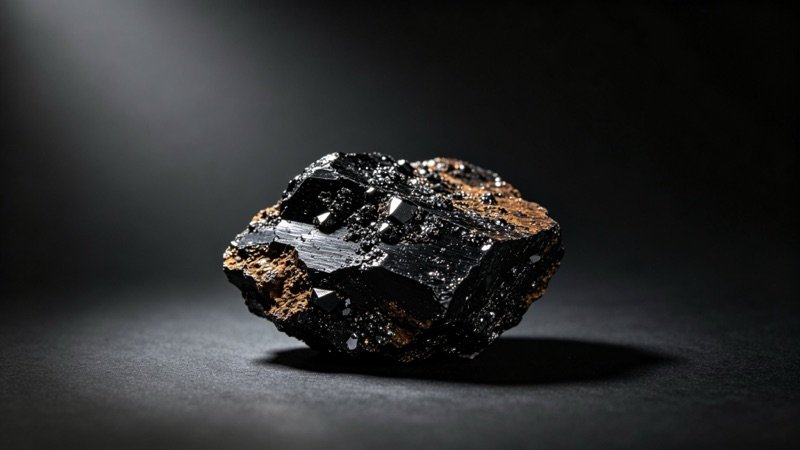
Discovered in 1802 by Anders Gustaf Ekeberg while analyzing columbite mineral from Finland. Distinguished from niobium (discovered simultaneously) in 1866 by Charles James. Isolated as pure metal in 1903. Currently recovered from tantalite (Fe,Mn)(Ta,Nb)₂O₆ deposits, primarily in Australia, Brazil, and Rwanda.

Alloys of this element (3)

View all alloys → Ta-10W Ta-2.5W TaSi2

Related Elements

Sc · Scandium Ti · Titanium V · Vanadium Cr · Chromium Mn · Manganese Fe · Iron Co · Cobalt Ni · Nickel

Frequently Asked QuestionsLong-tail Q&A · data-driven

What is the melting point of Tantalum?
3017 °C
What is the boiling point of Tantalum?
5458 °C
What is the density of Tantalum?
16.69 g/cm³
What are the atomic number and category of Tantalum?
73 · Transition Metal
Which ore is Tantalum mainly extracted from?
coltan
What are the world reserves of Tantalum?
100000 tonnes Ta
What is the annual production of Tantalum?
1800 tonnes Ta
What are the main uses of Tantalum?
Tantalum has the highest capacitance of any metal per unit volume — enabling the world's smallest and highest-capacity electrolytic capacitors used in every smartphone and tablet. Its self-passivating oxide layer and ext
Who discovered Tantalum and when?
Anders Gustaf Ekeberg · 1802