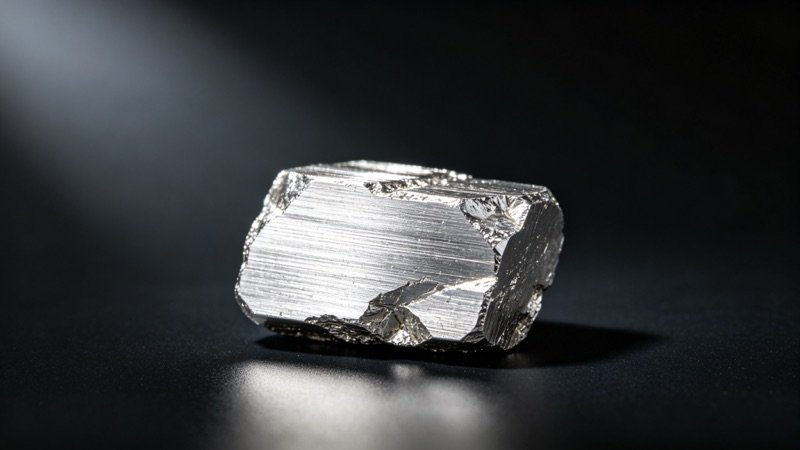
Holmium is a heavy rare earth of very low crustal abundance, but it occupies irreplaceable positions in two directions: strong magnetism and mid-infrared lasers. The holmium atom has the highest effective magnetic moment in the lanthanide series; using holmium metal or holmium alloys as magnetic poles and flux concentrators can produce an extremely strong local magnetic field in a small volume, which is used in high-field nuclear magnetic resonance and strong-magnetic-field research facilities. Holmium-doped yttrium aluminum garnet (Ho:YAG) lasers emit mid-infrared light around 2.1 µm; this wavelength is strongly absorbed by water, giving good cutting and hemostasis in surgery, and is widely used in urological lithotripsy, prostate resection, arthroscopy, and ophthalmic surgery. Holmium ions also have characteristic absorption at certain wavelengths, used to color glass and ceramics and as a filter in optical glass. Although holmium is not used in large total quantities, every application is a high-precision, high-value-added one.
Ho2O3 (holmium(III) oxide) is the principal oxide of holmium. It is a pale yellow powder and the starting point for preparing holmium metal, Ho:YAG laser crystals, and special glasses; on its own it also serves as a glass colorant and as a dopant in optical filters, used to make standard filters that absorb specific wavelengths and to calibrate wavelength in spectroscopic instruments. HoCl3 (holmium trichloride) is an intermediate in the extraction and separation flowsheet, used for the electrolytic production of holmium metal and the synthesis of holmium organometallic complexes. Because holmium ions have a rich set of energy levels, holmium oxide is also used as a dopant feedstock for certain mid-infrared lasers and fiber amplifiers, and as an additive in microwave substrate ceramics; although its use is small in volume, it appears frequently in research and high-end optical devices.