Home/ Elements/ Hf
Hafnium
Hf 72

Hafnium

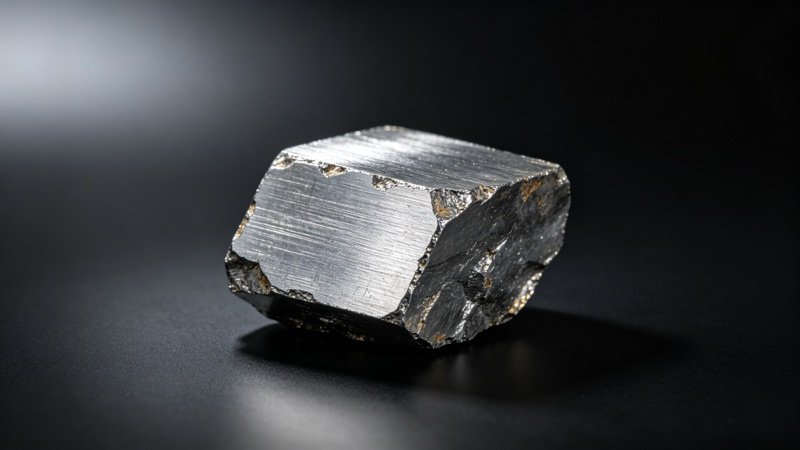
Hafnium is a chemical element; it has symbol Hf and atomic number 72. A lustrous, silvery gray, tetravalent transition metal, hafnium chemically resembles zirconium and is found in many zirconium minerals. Its existence was predicted by Mendeleev in 1869. Hafnium was finally identified in zircon from Norway, by two Coster and Georg von Hevesy, in 1923. Hafnium is used in nuclear reactors as a neutron absorber (control rods), in plasma cutting electrodes, and in microelectronics as a high-κ dielectric.

Transition Metal USGS 2025 steel gray
Atomic number 72Z
Atomic mass 178.492u
Valence e⁻ 2
Electron config. 1s2 2s2 2p6 3s2 3p6 4s2 3d10 4p6 5s2 4d10 5p6 6s2 4f14 5d2
Density
13.31g/cm³
Melting point
2233°C
Crustal abundance
3.0ppm
Annual production
70tonnes Hf
Recycling rate
Low

Why This Element

Hafnium has a thermal neutron absorption cross-section of 105 barns — 600 times that of zirconium — making it irreplaceable as nuclear reactor control rod material. Its high melting point and corrosion resistance also make it valuable to semiconductor manufacturing (gate dielectrics) and plasma cutting electrodes.

Applications

Reactor control rodsHigh-k dielectricsSpark plugs

Applications in DepthElement & compound uses

Main Uses of the Element

Hafnium is a rare, refractory metal that looks like steel and resists corrosion, and its core value runs along two main lines: nuclear performance and semiconductor performance. In the nuclear industry, hafnium has an extremely high thermal-neutron absorption cross-section, making it one of the preferred materials for control rods in pressurized water reactors; after absorbing neutrons it remains long-lived, radiation-resistant and resistant to corrosion by primary-loop coolant, so a single control-rod assembly can serve in-reactor for years, directly governing reactor power regulation and emergency shutdown safety. In the semiconductor industry, hafnium dioxide as a high-k gate dielectric replaced the silicon dioxide gate oxide that had served for decades in advanced logic chips at the 45-nanometer node and below, letting transistor gates continue to shrink without a surge in leakage current - one of the most important material shifts in integrated-circuit manufacturing over the past two decades, and essential to nearly every modern CPU, GPU and mobile SoC. Hafnium is also used in high-performance spark plugs, plasma-cutting electrodes, refractory alloys and heat-resistant coatings, as well as certain specialty X-ray targets and plasma-etch electrodes. Because hafnium and zirconium are near-twins chemically and always occur together in nature, separation is extremely difficult; hafnium has long been a by-product of zirconium smelting, produced in small quantities but at high value.

Key Compounds and Their Uses

Hafnium dioxide (HfO2) is hafnium's most important compound in the semiconductor era; as a high-k gate dielectric it has become the standard material in advanced CMOS chips, and is also used as a high-refractive-index thin film in optical coatings and as a high-temperature ceramic. Hafnium tetrachloride (HfCl4) is a key intermediate in hafnium smelting and chemical vapor deposition, used to produce hafnium metal, hafnium-dioxide thin films and certain catalysts. Hafnium carbide (HfC) is one of the highest-melting binary compounds known, with a melting point near 3,900 degrees C; extremely hard and highly ablation-resistant, it is used in rocket nozzles, leading edges of re-entry vehicles, high-temperature furnace linings and superhard coatings on cutting tools, occupying a unique position among materials for extreme thermal environments. Beyond these, hafnium oxychloride, hafnium oxynitride and similar compounds are used only in small quantities in semiconductor precursors and specialty optical coatings, and do not enter mass consumer products.
Element History

The last stable element to be discovered. Predicted by Mendeleev as 'eka-zirconium' in 1869. Finally discovered in 1923 by Coster and de Hevesy via X-ray fluorescence spectroscopy on mineral samples from Norway and Greenland. Separated from zirconium via liquid-liquid extraction, finally producing pure hafnium in the 1940s. Currently recovered as a byproduct of zirconium refining.

Related Elements

Sc · Scandium Ti · Titanium V · Vanadium Cr · Chromium Mn · Manganese Fe · Iron Co · Cobalt Ni · Nickel

Frequently Asked QuestionsLong-tail Q&A · data-driven

What is the melting point of Hafnium?
2233 °C
What is the boiling point of Hafnium?
4603 °C
What is the density of Hafnium?
13.31 g/cm³
What are the atomic number and category of Hafnium?
72 · Transition Metal
Which ore is Hafnium mainly extracted from?
Zircon
What are the world reserves of Hafnium?
100000 tonnes
What is the annual production of Hafnium?
70 tonnes Hf
What are the main uses of Hafnium?
Hafnium has a thermal neutron absorption cross-section of 105 barns — 600 times that of zirconium — making it irreplaceable as nuclear reactor control rod material. Its high melting point and corrosion resistance also ma
Who discovered Hafnium and when?
Dirk Coster · 1923